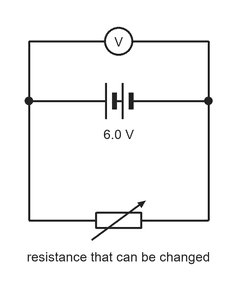
Solution:
Concept: The e.m.f. ε of a cell is the p.d. across its terminals when it sends no current (open circuit). When it sends a current I through an external resistance R, a part Ir of the e.m.f. is used up inside the cell (internal resistance r), so the terminal voltage is V = ε − Ir, and ε = I(R + r). A high-resistance voltmeter across the battery reads its terminal voltage.
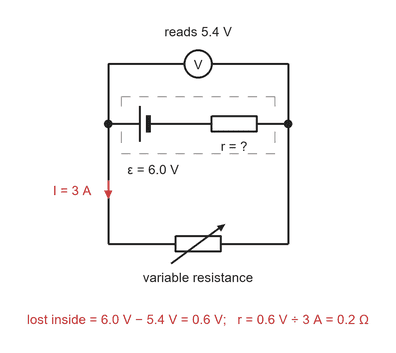
Given: ε = 6.0 V, terminal voltage V = 5.4 V, I = 3 A.
Step 1 — Find the voltage used up inside the battery.
The e.m.f. is 6.0 V but the terminals show only 5.4 V, so the difference is the drop Ir across the internal resistance.
Ir=ε−V=6.0−5.4=0.6 V
Step 2 — Find the internal resistance.
Divide this drop by the current that flows through the battery.
r=30.6=0.2 Ω
Watch out: Divide the DIFFERENCE ε − V by the current, not the voltmeter reading 5.4 V.
Therefore, the internal resistance of the battery is 0.2 Ω.