
Question 1054 marksEasy
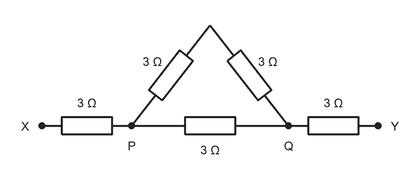
Five resistors, each of 3 Ω, are connected as shown in Fig 8.50. Calculate the resistance (a) between the points P and Q, and (b) between the points X and Y.
Confirming your payment
Sign up now and get 250 free tokens.
Current Electricity · Question 105 of 160
Five resistors, each of 3 Ω, are connected as shown in Fig 8.50. Calculate the resistance (a) between the points P and Q, and (b) between the points X and Y.
Solution:
Concept: In series the same current flows through each resistor, the p.d.s add up (V = V₁ + V₂ + …), and the equivalent resistance is R = R₁ + R₂ + …, more than the largest one. In parallel the p.d. is the same across each resistor, the currents add up (I = I₁ + I₂ + …), and the equivalent resistance is given by 1/R = 1/R₁ + 1/R₂ + …, less than the smallest one. For two resistors, R = R₁R₂ ÷ (R₁ + R₂).
Given: five resistors of 3 Ω each.
(a)
Step 1 — Find the two paths from P to Q.
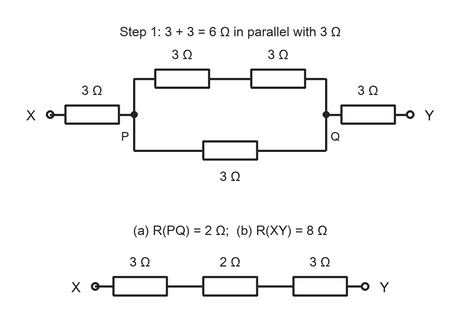
One path is the base resistor PQ alone. The other goes over the top of the triangle through the two sloping resistors, which are in series.
Step 2 — Combine the two paths.
Both paths join P to Q, so they are in parallel.
(b)
Step 3 — Add the end resistors.
Between X and Y, the 3 Ω from X to P, the triangle ( = 2 Ω) and the 3 Ω from Q to Y carry the same current, so they are in series.
Watch out: Between P and Q the outer resistors (X to P and Q to Y) carry no current, so leave them out of part (a).
Therefore, (a) the resistance between P and Q is 2 Ω, and (b) between X and Y it is 8 Ω.