
Question 1003 marksEasy
A uniform wire with a resistance of 27 Ω is divided into three equal pieces and then they are joined in parallel. Find the equivalent resistance of the parallel combination.
Confirming your payment
Sign up now and get 250 free tokens.
Current Electricity · Question 100 of 160
A uniform wire with a resistance of 27 Ω is divided into three equal pieces and then they are joined in parallel. Find the equivalent resistance of the parallel combination.
Solution:
Concept: The resistance of a wire is R = ρl ÷ a, where l is its length, a its area of cross-section and ρ the specific resistance (resistivity) of its material. So R ∝ l and R ∝ 1/a; for a wire of radius r, a = πr², so R ∝ 1/r². In parallel the p.d. is the same across each resistor, the currents add up (I = I₁ + I₂ + …), and the equivalent resistance is given by 1/R = 1/R₁ + 1/R₂ + …, less than the smallest one. For two resistors, R = R₁R₂ ÷ (R₁ + R₂).
Given: whole wire = 27 Ω, cut into 3 equal pieces, joined in parallel.
Step 1 — Find the resistance of each piece.
The wire is uniform, so its resistance is proportional to its length. Each piece is one-third of the length, so it has one-third of the resistance.
Step 2 — Join the three pieces in parallel.
For n equal resistors, each of resistance R₀, in parallel, the equivalent resistance is R₀ ÷ n.
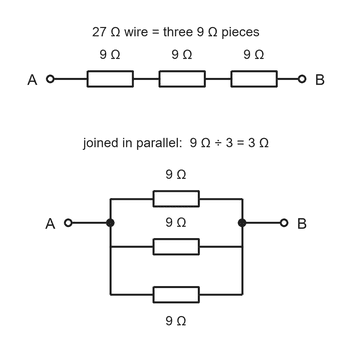
Step 3 — See why it falls ninefold.
Each piece has one-third of the length, and joining three side by side gives three times the area, so the resistance falls to 27 ÷ 9 = 3 Ω.
Watch out: Do not divide 27 Ω by 3 only once; cutting gives 9 Ω pieces, and joining them in parallel divides by 3 again.
Therefore, the equivalent resistance of the parallel combination is 3 Ω.