
Question 1504 marksMedium
What is the resistance, under normal working conditions, of an electric lamp rated '240 V, 60 W' ? If two such lamps are connected in series across a 240 V mains supply, explain why each one appears less bright.

Confirming your payment
Sign up now and get 250 free tokens.
Current Electricity · Question 150 of 160
What is the resistance, under normal working conditions, of an electric lamp rated '240 V, 60 W' ? If two such lamps are connected in series across a 240 V mains supply, explain why each one appears less bright.
Solution:
Concept: A rating such as '100 W, 220 V' means the appliance uses 100 W when connected to 220 V. From it, the resistance is R = V² ÷ P and the safe (normal working) current is I = P ÷ V. In series the same current flows through both lamps, and the supply voltage is shared between them.
Given: rating 240 V, 60 W; two lamps in series across 240 V.
Step 1 — Find the resistance of one lamp.
We use R = V² ÷ P with the rated values.
Step 2 — Find the current in series.
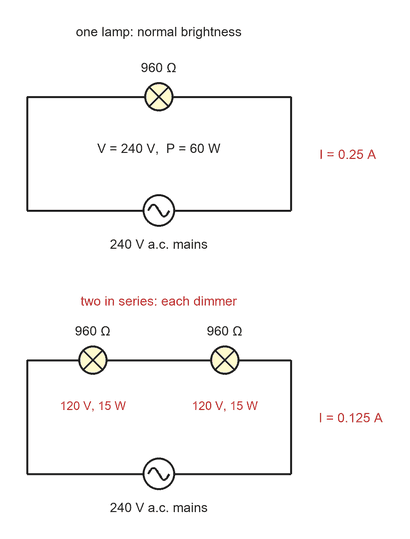
In series the resistances add to 960 Ω + 960 Ω = 1920 Ω, and the 240 V mains drives the current through this total.
This is half the normal current of one lamp alone on the mains (240 ÷ 960 = 0.25 A).
Step 3 — Find the voltage across each lamp.
The two equal lamps share the 240 V equally.
Step 4 — Find the power in each lamp.
We use P = I²R with the series current.
Step 5 — Explain the dimness.
Each lamp gets only half its rated voltage, so the current is halved and the power (P = V² ÷ R) is one-fourth of normal: 15 W instead of 60 W. The filament is heated much less, so each lamp gives much less light and appears less bright.
Watch out: Halving the voltage does not halve the power; it makes it one-fourth.
Therefore, the resistance of each lamp is 960 Ω, and in series each lamp gets only 120 V and uses only 15 W instead of 60 W, so each appears less bright.