
Question 731 markMCQEasy
For parallel combination of resistances, which of the statements are correct ?
Confirming your payment
Sign up now and get 250 free tokens.
Current Electricity · Question 73 of 160
For parallel combination of resistances, which of the statements are correct ?
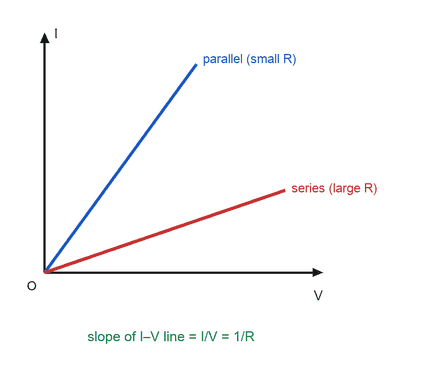
(A) On I-V graph, the slope of line is more.
(B) The potential difference across each resistance is same.
(C) The current in a resistor is inversely proportional to the resistance.
(D) All of the above
Answer: (D) All of the above
Concept: In parallel, every resistor has the same p.d. V across it, and the equivalent resistance is less than any of the resistors. On an I–V graph (current I on the y-axis, p.d. V on the x-axis), the slope of the line is I ÷ V, which is 1/R.
Step 1 — Check statement (A).
A parallel combination has a smaller resistance than each of its resistors (and than the same resistors in series). So its 1/R is larger, and its line on the I–V graph has a larger slope. Statement (A) is true.
Step 2 — Check statement (B).
All the resistors are joined between the same two points, so the same p.d. is across each one. Statement (B) is true.
Step 3 — Check statement (C).
Since the p.d. V is the same for every resistor, Ohm's law gives the current in each one. A resistor with twice the resistance takes half the current, so the current is inversely proportional to the resistance. Statement (C) is true.
Step 4 — Choose the option.
All three statements are true, so the answer is the option that includes all of them.
Watch out: Statement (A) takes I on the y-axis; on a V–I graph (V on the y-axis) the slope is R, and the parallel line would be the LESS steep one.
Why the other options are wrong:
Therefore, all of the statements are correct for a parallel combination, option (D).