
Question 1221 markMCQEasy
A bulb is rated 100 W -220 V. It is being used at 110 V supply. The power consumed by bulb is ::
Confirming your payment
Sign up now and get 250 free tokens.
Current Electricity · Question 122 of 160
A bulb is rated 100 W -220 V. It is being used at 110 V supply. The power consumed by bulb is ::
(A) 100 W
(B) half of 100 W
(C) nearly 25 W
(D) none of the above
Answer: (C) nearly 25 W
Concept: A rating such as '100 W, 220 V' means the appliance uses 100 W when connected to 220 V. From it, the resistance is R = V² ÷ P and the safe (normal working) current is I = P ÷ V. The resistance of the filament stays (nearly) the same at the lower voltage, so from P = V² ÷ R the power goes as the square of the voltage.
Step 1 — Find the resistance from the rating.
We use R = V² ÷ P with the rated 220 V and 100 W.
Step 2 — Find the power at 110 V.
With the same resistance, the power on the 110 V supply is V² ÷ R.
Step 3 — See the pattern.
Halving the voltage makes the power one-fourth of the rated 100 W.
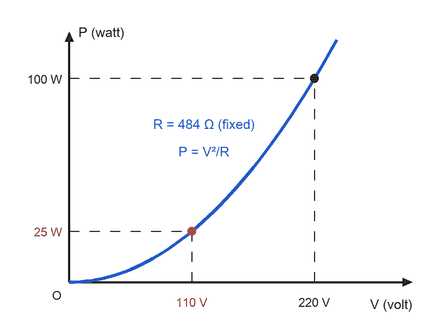
Step 4 — See why the option says 'nearly'.
At 110 V the filament is cooler, so its resistance is a little lower than 484 Ω. The real power is therefore a little more than 25 W, which is why the option says 'nearly 25 W'.
Watch out: Power does not fall in the same ratio as the voltage; since P = V² ÷ R, half the voltage gives one-fourth the power.
Why the other options are wrong:
Therefore, the power consumed by the bulb on 110 V is nearly 25 W, option (C).