
Question 711 markMCQEasy
In series combination of resistances :
Confirming your payment
Sign up now and get 250 free tokens.
Current Electricity · Question 71 of 160
In series combination of resistances :
(A) p.d. is the same across each resistance
(B) total resistance is reduced
(C) current is same in each resistance
(D) all of the above are true
Answer: (C) current is same in each resistance
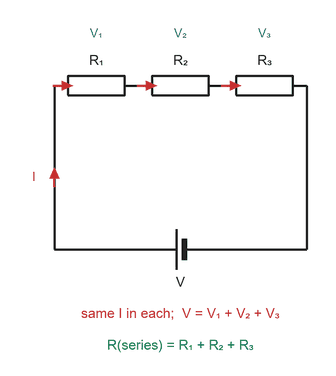
Concept: In series the same current flows through each resistor, the p.d.s add up (V = V₁ + V₂ + …), and the equivalent resistance is R = R₁ + R₂ + …, more than the largest one.
Step 1 — Look at the paths.
In series the resistors are joined end to end, so the charge has only one path through them.
Step 2 — Compare the currents.
All the charge that passes through the first resistor must pass through each of the others as well. So the same current I flows through each resistor.
Step 3 — Compare the p.d.s and the total.
The p.d. of the battery divides among the resistors, with the larger share across the larger resistance. The total resistance is the sum of all of them, so it is more than any one.
Watch out: The same current is the series property; the same p.d. is the parallel property.
Why the other options are wrong:
Therefore, in a series combination the current is the same in each resistance, option (C).