
Question 171 markMCQEasy
For which of the following substances, resistance decreases with the increase in temperature :
Confirming your payment
Sign up now and get 250 free tokens.
Current Electricity · Question 17 of 160
For which of the following substances, resistance decreases with the increase in temperature :
(A) copper
(B) mercury
(C) carbon
(D) platinum
Answer: (C) carbon
Concept: With a rise in temperature the resistance of a metal increases, that of an alloy (manganin, constantan, nichrome) increases only very slightly, and that of a semiconductor or carbon decreases.
Step 1 — Sort the substances.
Copper, mercury and platinum are metals, while carbon is not a metal; it behaves like a semiconductor.
Step 2 — Apply the rule for metals.
When a metal is heated, its ions vibrate more and the free electrons collide more often, so the resistance of copper, mercury and platinum increases.
Step 3 — Apply the rule for carbon.
When carbon is heated, more charge carriers become free to move, so it conducts better and its resistance decreases.
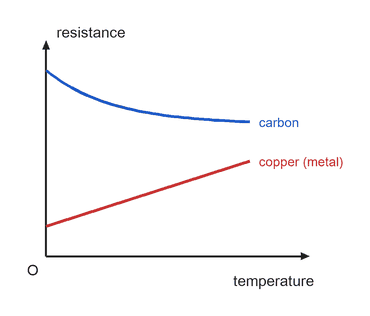
Why the other options are wrong:
Therefore, the resistance of carbon decreases with an increase in temperature, option (C).