
Question 131 markMCQEasy
The resistance of a conductor depends on :
Confirming your payment
Sign up now and get 250 free tokens.
Current Electricity · Question 13 of 160
The resistance of a conductor depends on :
(A) the temperature of the conductor
(B) the thickness of the conductor
(C) the length of the conductor
(D) all of the above
Answer: (D) all of the above
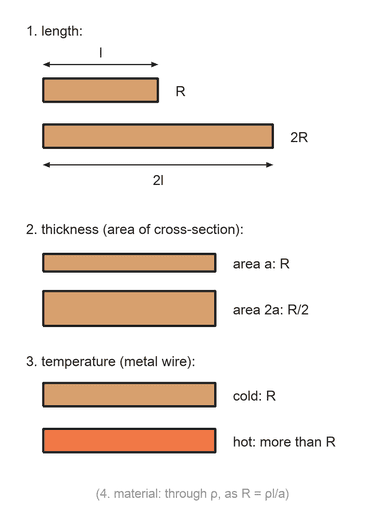
Concept: The resistance of a wire is R = ρl ÷ a, where l is its length, a its area of cross-section and ρ the specific resistance (resistivity) of its material. So R ∝ l and R ∝ 1/a; for a wire of radius r, a = πr², so R ∝ 1/r². With a rise in temperature the resistance of a metal increases, that of an alloy (manganin, constantan, nichrome) increases only very slightly, and that of a semiconductor or carbon decreases.
Step 1 — Look at the length.
A longer wire makes the electrons suffer more collisions on the way, so the resistance is directly proportional to the length (R ∝ l).
Step 2 — Look at the thickness.
A thicker wire has a larger area of cross-section, which lets more electrons flow side by side, so the resistance is inversely proportional to the area (R ∝ 1/a).
Step 3 — Look at the temperature.
When a metal wire is heated, its ions vibrate more and the electrons collide more often, so its resistance increases.
Step 4 — Choose the option.
The resistance depends on the temperature, the thickness and the length (and also on the material, through ρ), so all three options are correct.
Why the other options are wrong:
Therefore, the resistance depends on all of the above, option (D).