
Question 514 marksEasy
What is an ohmic resistor ? Give one example of an ohmic resistor. Draw a graph to show its current-voltage relationship. How is the resistance of the resistor determined from this graph ?
Confirming your payment
Sign up now and get 250 free tokens.
Current Electricity · Question 51 of 160
What is an ohmic resistor ? Give one example of an ohmic resistor. Draw a graph to show its current-voltage relationship. How is the resistance of the resistor determined from this graph ?
Solution:
Concept: Ohm's law: the current in a conductor is directly proportional to the p.d. across its ends, provided its physical conditions (temperature) stay the same. So V = IR, where R is the resistance, measured in ohm (1 Ω = 1 V A⁻¹).
Step 1 — Define an ohmic resistor.
A conductor which obeys Ohm's law is called an ohmic resistor. The current through it is directly proportional to the potential difference across it, so V ÷ I (its resistance) is the same for all values of V or I.
Step 2 — Give an example.
A nichrome wire is an ohmic resistor; so is any metallic conductor, such as a copper or silver wire, kept at a constant temperature.
Step 3 — Draw the current–voltage graph.
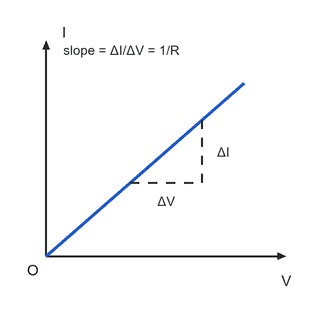
Plot the current I on the y-axis against the voltage V on the x-axis. The graph is a straight line passing through the origin.
Step 4 — Find the resistance from the graph.
Take two points on the line and read the change in current ΔI and the change in voltage ΔV between them. The slope ΔI ÷ ΔV is 1/R, so the resistance is the reciprocal of the slope.
Step 5 — See an example of the reading.
Suppose (as an example only) the current rises by 0.5 A when the voltage rises by 1 V. Then the resistance is
Watch out: On the I–V graph R is the reciprocal of the slope; it is the slope itself only on a V–I graph.
Therefore, an ohmic resistor obeys Ohm's law (e.g. a nichrome wire); its I–V graph is a straight line through the origin, and its resistance is the reciprocal of the slope, R = ΔV ÷ ΔI.