
Question 855 marksEasy
How would you connect two resistors in series ? Draw a diagram. Calculate the total equivalent resistance.
Confirming your payment
Sign up now and get 250 free tokens.
Current Electricity · Question 85 of 160
How would you connect two resistors in series ? Draw a diagram. Calculate the total equivalent resistance.
Solution:
Concept: In series the same current flows through each resistor, the p.d.s add up (V = V₁ + V₂ + …), and the equivalent resistance is R = R₁ + R₂ + …, more than the largest one.
Step 1 — Make the connection.
Join one end of R₁ to one end of R₂. Then connect the free end of R₁ and the free end of R₂ to the two terminals of the battery (through a key), so that there is only one path for the current.
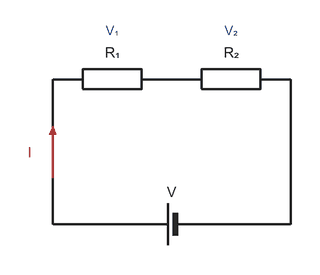
Step 2 — Write the p.d. across each resistor.
The same current I flows through R₁ and R₂, so by Ohm's law the p.d. across each is I times its resistance.
Step 3 — Add the p.d.s.
The p.d. V of the battery is shared between the two resistors, so it is the sum of V₁ and V₂.
Step 4 — Bring in the equivalent resistance.
If Rₛ is the equivalent resistance, it carries the same current I for the same p.d. V, so V = IRₛ. Put this equal to the result of Step 3.
Step 5 — Cancel the current.
Divide both sides by I.
For example, 2 Ω and 3 Ω in series give 2 + 3 = 5 Ω.
Watch out: In series the current is the same in each resistor, and it is the p.d.s (not the currents) that add.
Therefore, the total equivalent resistance of two resistors in series is Rₛ = R₁ + R₂, more than either of them.