
Question 1384 marksMedium
Two lamps, one rated 220 V, 50 W and the other rated 220 V, 100 W, are connected in series with mains of voltage 220 V.
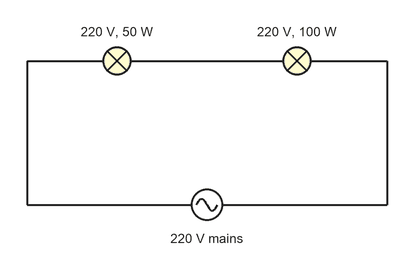
Explain why does the 50 W lamp consume more power.
Confirming your payment
Sign up now and get 250 free tokens.
Current Electricity · Question 138 of 160
Two lamps, one rated 220 V, 50 W and the other rated 220 V, 100 W, are connected in series with mains of voltage 220 V.
Explain why does the 50 W lamp consume more power.
Solution:
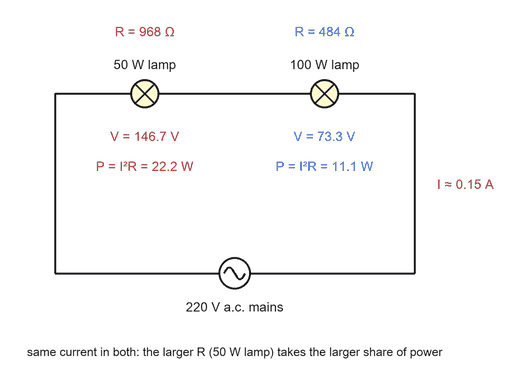
Concept: In a series circuit the same current flows through both lamps. With the same current, P = I²R, so the lamp with the larger resistance takes the larger power. At the same rated voltage, a lower power rating means a larger resistance, since R = V² ÷ P.
Step 1 — Find the resistance of each lamp.
We use R = V² ÷ P with each lamp's rating.
So the 50 W lamp has twice the resistance of the 100 W lamp.
Step 2 — Find the current in the series circuit.
In series the resistances add, and the 220 V mains drives one current through both lamps.
Step 3 — Find the power in each lamp.
Since the current is the same, we use P = I²R for each lamp.
Step 4 — Explain the result.
With the same current, the power is proportional to the resistance. The 50 W lamp has the larger resistance, so it takes twice the power (about 22 W against 11 W), gets the larger share of the voltage (about 147 V against 73 V) and glows brighter.
Watch out: The '50 W' and '100 W' are the powers only when each lamp has the full 220 V across it alone; in series neither lamp gets 220 V.
Therefore, the 50 W lamp consumes more power because it has the larger resistance (968 Ω) and the same current flows through both lamps in series, so P = I²R is larger for it.