Solution:
Concept: η = M.A. ÷ V.R. The V.R. is fixed by the arrangement, while the M.A. falls whenever part of the effort is used for anything other than lifting the load.
Step 1 — (a) Why V.R. is more than M.A.
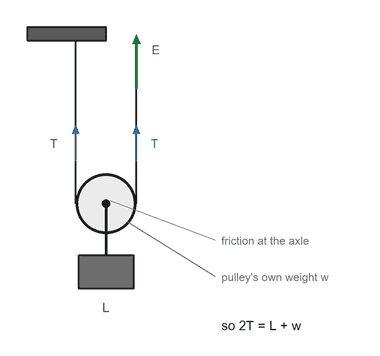
The V.R. of a single movable pulley is fixed at 2 by the arrangement. In practice part of the effort goes into lifting the pulley's own weight and overcoming friction, so the effort is more than half the load and the M.A. (L ÷ E) is less than 2. For example, if a 100 N load needs an effort of 60 N, the M.A. is as below.
M.A.=60100≈1.67
This is less than 2.
Step 2 — (b) Why the efficiency is less than 100%.
Some input work is always wasted: in lifting the weight of the movable pulley and against friction at its bearing. So the work output is less than the work input, and η (M.A. ÷ V.R.) is less than 1.
Step 3 — (c) Why more pulleys give a larger M.A.
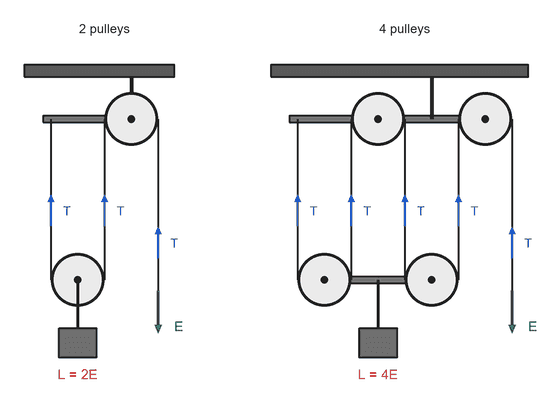
With more pulleys, more strands hold up the lower block. Each strand carries a tension equal to the effort, so ideally L = nE and the M.A. is n: more pulleys mean a larger n and a larger M.A.
Step 4 — (d) Why the lower block must be light.
The lower block moves up with the load, so the strands must hold up its weight w as well.
nE=L+w
So the efficiency falls as w grows.
η=1−nEw
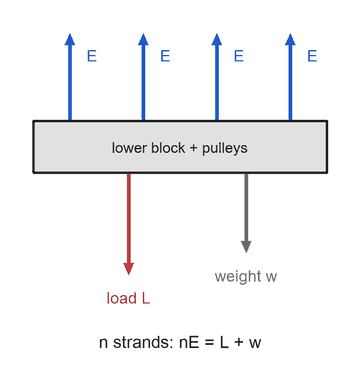
For example, with 4 strands of 100 N each, a 40 N block leaves only 360 N for the load.
η=1−4×10040=0.9
So the efficiency is only 90%. To keep the M.A. and the efficiency high, the lower block should be as light as possible.
Therefore, (a) friction and the pulley's weight make the M.A. less than the fixed V.R., (b) the same losses keep the efficiency below 100%, (c) more pulleys give more supporting strands and so a larger M.A., and (d) a heavy lower block wastes effort and lowers the M.A. and the efficiency, so it must be light.
