Solution:
Concept: The point about which the rod turns is the fulcrum. The stone pushes down on the rod (load) and the hand pushes up on the rod (effort). Levers are classed by which of the fulcrum (F), the load (L) and the effort (E) lies in the middle: F in the middle → class I; L in the middle → class II; E in the middle → class III.
(a)
Step 1 — Mark the fulcrum.
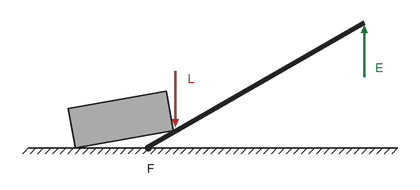
The rod turns about its lower end, which rests on the ground under the edge of the stone, so the fulcrum F is there.
Step 2 — Mark the load and the effort.
The load L is the weight of the stone acting downward where the stone rests on the rod, just beside F. The effort E acts upward at the far, upper end of the rod.
(b)
Step 3 — Name the class.
The load is between the fulcrum and the effort, so the rod is a class II lever. Its effort arm (almost the whole rod) is much longer than its load arm, so it lifts the heavy stone with a small effort.
(c)
Step 4 — Give another example.
Another class II lever is a wheel barrow (or a nut cracker, or a bottle opener).
Therefore, F is at the end of the rod on the ground, L acts down at the stone and E acts up at the far end; the rod is a class II lever, like a wheel barrow.

