
Question 344 marksEasy
Name the three classes of levers and state how are they distinguished. Give two examples of each class.
Confirming your payment
Sign up now and get 250 free tokens.
Machines · Question 34 of 109
Name the three classes of levers and state how are they distinguished. Give two examples of each class.
Solution:
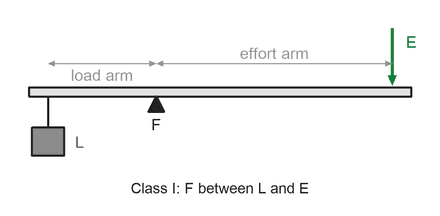
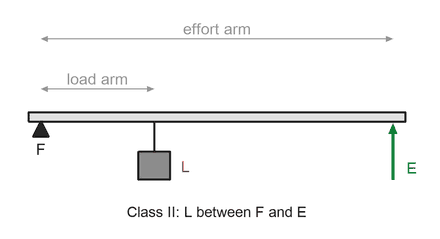
Concept: Levers are classified by the relative positions of the fulcrum (F), the load (L) and the effort (E), that is, by which one lies in the middle. For a lever, M.A. = effort arm ÷ load arm.
Step 1 — Class I lever.
The fulcrum is between the load and the effort. Its M.A. can be more than, equal to or less than 1. Examples: a seesaw and a common balance (also scissors, a crowbar, pliers).
Step 2 — Class II lever.
The load is between the fulcrum and the effort. The effort arm is always longer, so M.A. > 1. Examples: a nut cracker and a wheel barrow (also a bottle opener, a lemon crusher).
Step 3 — Class III lever.
The effort is between the fulcrum and the load. The effort arm is always shorter, so M.A. < 1. Examples: sugar tongs and a fishing rod (also forceps, the human forearm).
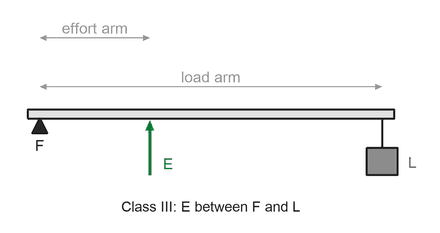
Therefore, the three classes are class I (fulcrum in the middle), class II (load in the middle) and class III (effort in the middle).