Solution:
Concept: The rivet is the fulcrum. The cloth (load) is 8.0 cm from it and the fingers (effort) are 2.0 cm from it. For a lever, M.A. = effort arm ÷ load arm, and the load L = M.A. × E.
Given: Load arm = 8.0 cm; effort arm = 2.0 cm; effort E = 10 kgf.
(a)
Step 1 — (i) Find the mechanical advantage.
Divide the effort arm by the load arm.
M.A.=Load armEffort arm=8.0 cm2.0 cm=0.25
Step 2 — (ii) Find the load offered by the cloth.
Since M.A. = L ÷ E, the load is the M.A. times the effort.
L=M.A.×E=0.25×10 kgf=2.5 kgf
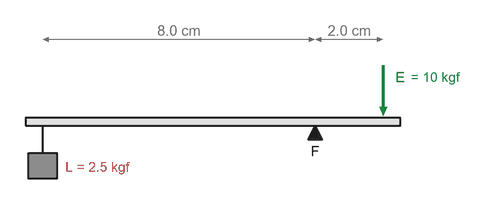
Check: The moments about the rivet balance.
2.5×8.0=20 kgf cm
10×2.0=20 kgf cm
(b)
Step 3 — Decide how the scissors act.
M.A. is less than 1, so the scissors act as a speed multiplier: the blade moves 4 times as far as the fingers.
Watch out: The cloth is the load and the 10 kgf from the fingers is the effort.
Therefore, (a) M.A. = 0.25 and the cloth offers a load of 2.5 kgf, and (b) the scissors act as a speed multiplier.
