
Question 563 marksEasy
Fig. 3.15 below shows a lever in use.
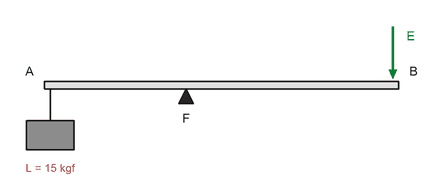
(a) To which class of lever does it belong ?
(b) If AB = 1 m, AF = 0.4 m, find its mechanical advantage.
(c) Calculate the value of E.
Confirming your payment
Sign up now and get 250 free tokens.
Machines · Question 56 of 109
Fig. 3.15 below shows a lever in use.
(a) To which class of lever does it belong ?
(b) If AB = 1 m, AF = 0.4 m, find its mechanical advantage.
(c) Calculate the value of E.
Solution:
Concept: Levers are classed by which of the fulcrum (F), the load (L) and the effort (E) lies in the middle: F in the middle → class I; L in the middle → class II; E in the middle → class III. A lever balances when the moments about its fulcrum are equal (principle of moments): load × load arm = effort × effort arm. Since M.A. is load ÷ effort, for a lever M.A. = effort arm ÷ load arm, where the load arm and the effort arm are the distances of the load and of the effort from the fulcrum.
Given: From the figure, load L = 15 kgf at A; AB = 1 m; AF = 0.4 m.
(a)
Step 1 — Name the class.
The fulcrum F is between the load (at A) and the effort (at B), so it is a class I lever.
(b)
Step 2 — Find the arms.
The load arm is AF; the effort arm is FB, the rest of the 1 m lever.
Step 3 — Find the mechanical advantage.
Divide the effort arm by the load arm.
(c)
Step 4 — Find the effort.
Since M.A. = L ÷ E, the effort is the load divided by the M.A.
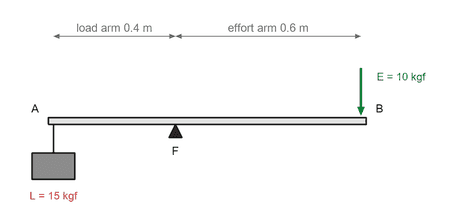
Check: The moments about F balance.
Watch out: The effort arm is FB = AB − AF, not AB.
Therefore, (a) it is a class I lever, (b) its mechanical advantage is 1.5, and (c) E = 10 kgf.