Solution:
Concept: Power is work ÷ time. The effort is the weight of the falling mass. For a single fixed pulley V.R. = 1, so the efficiency (M.A. ÷ V.R.) is simply L ÷ E.
Given: Falling mass 100 kg (its weight is the effort), falling 8.0 m in 4.0 s; load 75.0 kgf; force of gravity on 1 kg = 10 N.
Step 1 — Change the forces into newtons.
The force of gravity on 1 kg is 10 N, so the effort (weight of the 100 kg mass) and the load (75.0 kgf) are as below.
E=100×10=1000 N
L=75.0×10=750 N
(a)
Step 2 — Find the work input.
The effort moves 8.0 m in 4.0 s, so the work input is effort × distance.
Win=E×dE=1000×8.0=8000 J
Step 3 — Find the power input.
Power is work divided by time.
Pin=tWin=4.0 s8000 J=2000 W
(b)
Step 4 — Find the efficiency.
For a single fixed pulley V.R. = 1, and the M.A. is L ÷ E.
M.A.=1000750=0.75
η=V.R.M.A.=10.75=0.75
That is 75%.
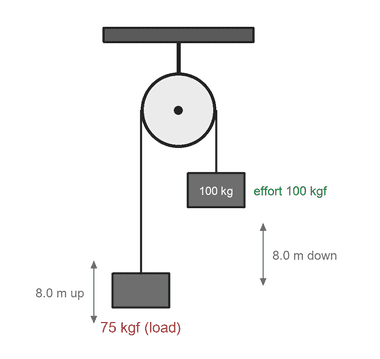
Check: The work output divided by the work input gives the same efficiency.
Wout=750×8.0=6000 J
η=80006000=0.75
(c)
Step 5 — Find the height the load rises.
V.R. = 1, so the load rises the same distance as the effort moves in the same 4.0 s, that is 8.0 m.
Watch out: The power input uses the work done by the effort (1000 N × 8.0 m), not the work done on the load.
Therefore, (a) the power input is 2000 W, (b) the efficiency is 0.75 (75%), and (c) the load is raised 8.0 m in 4.0 s.

