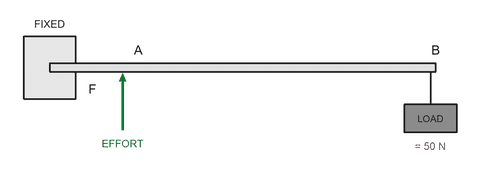
Solution:
Concept: The fixed end F is the fulcrum, and the effort acts at A between F and the load at B. A lever balances when the moments about its fulcrum are equal (principle of moments): load × load arm = effort × effort arm. Since M.A. is load ÷ effort, for a lever M.A. = effort arm ÷ load arm, where the load arm and the effort arm are the distances of the load and of the effort from the fulcrum.
Given: FA = 10 cm; AB = 490 cm; load L = 50 N.
(a)
Step 1 — State the principle for this lever.
In equilibrium, the moment of the load about F equals the moment of the effort about F.
Load×FB=Effort×FA
(b)
Step 2 — Name the class.
The effort (at A) is between the fulcrum F and the load (at B), so it is a class III lever. Example: sugar tongs (or a fishing rod, forceps).
(c)
Step 3 — Find the arms.
The effort arm is FA; the load arm FB is FA plus AB.
Effort arm FA=10 cm
Load arm FB=10+490=500 cm
Step 4 — (i) Find the mechanical advantage.
Divide the effort arm by the load arm.
M.A.=500 cm10 cm=501=0.02
Step 5 — (ii) Find the minimum effort.
Since M.A. = L ÷ E, the effort is the load divided by the M.A.
E=1/5050 N=50×50 N=2500 N
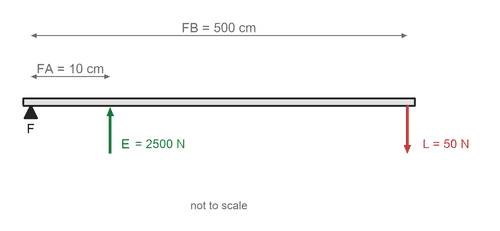
Watch out: The load arm is FB (FA + AB, 500 cm), not AB (490 cm).
Therefore, (a) load × FB = effort × FA; (b) it is a class III lever, like sugar tongs; (c) its M.A. is 1/50 and the minimum effort is 2500 N.