
Question 691 markMCQEasy
The mechanical advantage of an ideal single movable pulley is :
Confirming your payment
Sign up now and get 250 free tokens.
Machines · Question 69 of 109
The mechanical advantage of an ideal single movable pulley is :
(A) 1
(B) 2
(C) less than 2
(D) less than 1
Answer: (B) 2
Concept: In a single movable pulley the string is tied to a support, passes under the pulley and the effort pulls the free end up; the load hangs from the pulley. The load is held up by two strands, so ideally L = 2E (so its M.A. is 2), and to raise the load by d both strands must shorten by d, so the effort moves 2d (so its V.R. is 2).
Step 1 — Find the tension.
The effort pulls the free end of the string, so the tension T in the string equals the effort.
Step 2 — Balance the pulley.
Two strands, each with tension T, pull the pulley up and hold the load.
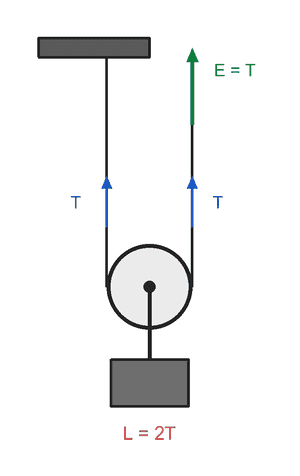
Watch out: 2 is the ideal value; a real movable pulley has an M.A. a little less than 2.
Why the other options are wrong:
Therefore, the M.A. of an ideal single movable pulley is 2, option (B).