
Question 11 markMCQEasy
Which of the following is not an example of a machine used as a force multiplier ?
Confirming your payment
Sign up now and get 250 free tokens.
Machines · Question 1 of 109
Which of the following is not an example of a machine used as a force multiplier ?
(A) A jack used to lift a car.
(B) A single fixed pulley used to lift a bucket of water from a well.
(C) A bar used to lift a heavy stone.
(D) A wheel barrow used to carry a load.
Answer: (B) A single fixed pulley used to lift a bucket of water from a well.
Concept: A machine is a force multiplier when its mechanical advantage (M.A. = load ÷ effort) is more than 1, so that a small effort overcomes a larger load.
Step 1 — Look at the single fixed pulley.
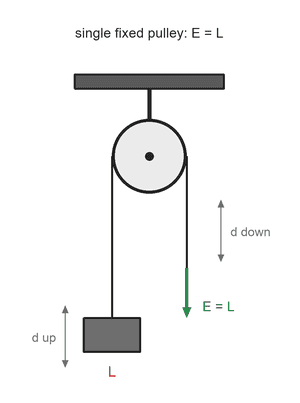
In a single fixed pulley one string passes over the pulley. The bucket hangs on one end and we pull the other end, so (with no friction) the effort equals the load.
Step 2 — Say what it does.
Its M.A. is only 1, so it does not multiply the force. It only changes the direction of the effort: we pull down to lift the bucket up, and can use our own weight to help.
Watch out: A single fixed pulley is useful, but for changing the direction of the force, not for reducing it.
Why the other options are wrong:
Therefore, the single fixed pulley used to lift a bucket of water is not a force multiplier, option (B).