
Question 504 marksEasy
What is the use of a lever if its mechanical advantage is (a) more than 1, (b) equal to 1, and (c) less than 1.
Confirming your payment
Sign up now and get 250 free tokens.
Machines · Question 50 of 109
What is the use of a lever if its mechanical advantage is (a) more than 1, (b) equal to 1, and (c) less than 1.
Solution:
Concept: For a lever, M.A. = effort arm ÷ load arm, and a gain in force is always paid for by a loss in distance (and the other way round).
Step 1 — (a) M.A. more than 1.
The lever acts as a force multiplier: a heavy load is overcome by a small effort, though the effort moves farther than the load. Examples: a crowbar, a nut cracker.
Step 2 — (b) M.A. equal to 1.
There is no gain in force or speed. The lever is used to change the direction of the effort or its point of application, or to compare two equal forces. Example: a common beam balance with equal arms.
Step 3 — (c) M.A. less than 1.
The lever acts as a speed multiplier: the load moves through a larger distance, and faster, than the effort, though more effort is needed. Examples: sugar tongs, the human forearm, scissors with long blades.
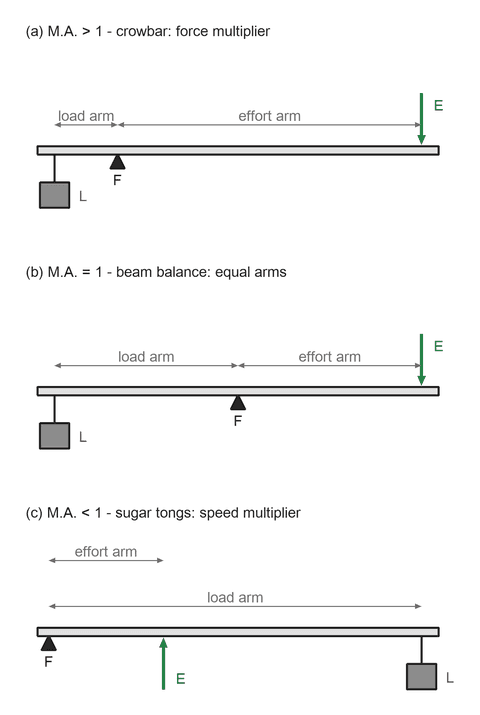
Therefore, a lever with M.A. more than 1 is used as a force multiplier, with M.A. equal to 1 to change the direction (or compare equal forces), and with M.A. less than 1 as a speed multiplier.