Solution:
Concept: A single movable pulley has M.A. 2 but needs an upward pull. A fixed pulley has M.A. 1, so adding one changes only the direction of the effort. If friction and the weight of the string are neglected, the tension T is the same all along one string, and in every strand it pulls the body at the end of that strand towards the pulley.
Step 1 — Find the direction of the effort.
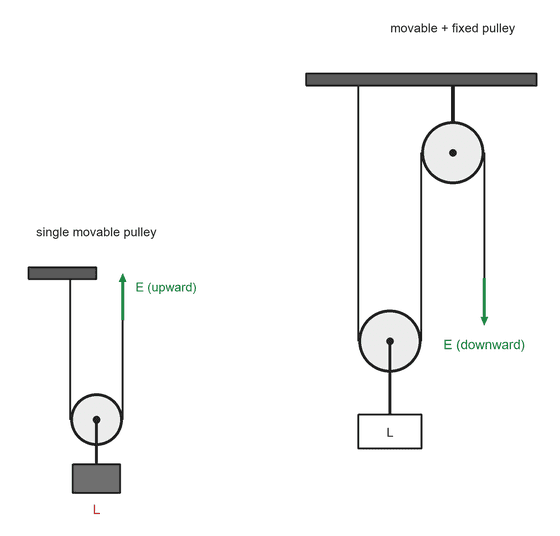
A single pulley with M.A. more than 1 is a movable pulley. Its free end has to be pulled upward, which is inconvenient because we cannot use our own weight.
Step 2 — Change the direction.
Pass the free end of the string over a fixed pulley attached to the support. The effort can then be applied downward. The fixed pulley only turns the string round; the load is still held by two strands, so the M.A. of the system stays 2.
Step 3 — Draw the labelled diagram.
In the diagram A is the movable pulley carrying the load L and B is the fixed pulley. The tension T is the same all along the string and points towards the pulley in every strand: up on A in both strands that hold it, and up on the hand at the effort end, where the effort E pulls down.
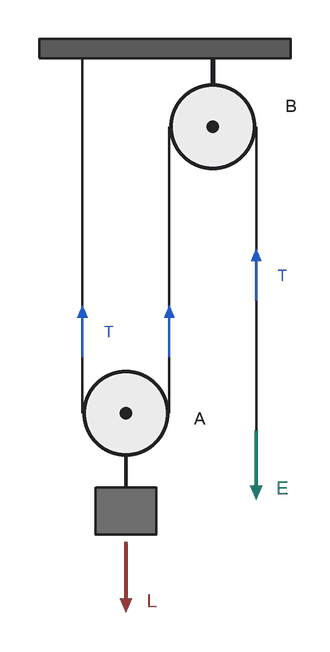
Two strands hold up A, so L = 2T; the effort strand gives E = T; so the M.A. is 2T ÷ T, that is 2.
Therefore, the effort on a single movable pulley must be applied upward; passing the string over a fixed pulley lets it be applied downward while the M.A. stays 2.
