Solution:
Concept: An e.m.f. is induced in a loop only while the magnetic flux linked with it changes; a steady flux, however large, induces nothing.
Step 1 — Look at case (i), a current started in the nearby wire.
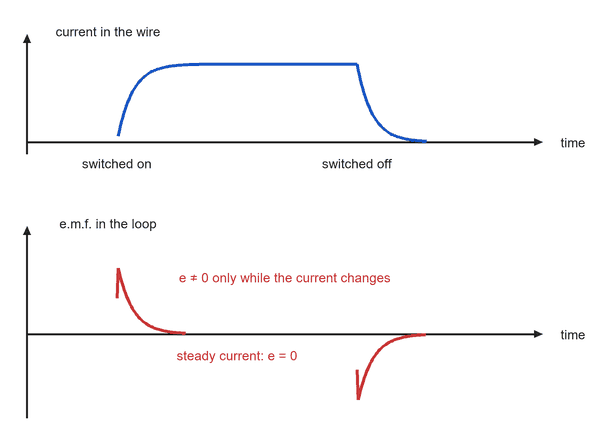
When the current in the wire is switched on, it grows from zero, so its magnetic field through the loop grows and the flux linked with the loop increases. An e.m.f. is induced.
Step 2 — Look at case (ii), the current switched off.
When the current is switched off, the field of the wire dies away and the flux through the loop falls to zero. An e.m.f. is induced, in the opposite direction to case (i).
The figure shows a short pulse of e.m.f. in the loop when the current is switched on, zero e.m.f. while the current stays steady, and a pulse the other way when it is switched off.
Step 3 — Look at case (iii), a magnet moved through the loop.
As the magnet moves, the number of its field lines passing through the loop changes, so an e.m.f. is induced.
Step 4 — Look at case (iv), a loop held near a magnet.
The loop and the magnet are both at rest, so the flux through the loop stays constant and no e.m.f. is induced.
Watch out: It is the change of flux that matters, not the presence of a field: a strong magnet at rest beside a loop induces nothing.
Therefore, an e.m.f. is induced in cases (i), (ii) and (iii), but not in case (iv).
