Solution:
Concept: A transformer works on mutual induction and only with a.c.: the changing current in the primary coil sets up a changing flux in the soft iron core, and this changing flux, linked with the secondary coil, induces an e.m.f. in it. The e.m.f. per turn is the same in both coils, so Es ÷ Ep is equal to Ns ÷ Np (the turns ratio). In an ideal transformer the power in equals the power out, so the current changes the opposite way: Is ÷ Ip is equal to Np ÷ Ns.
(i)
Step 1 — Compare the turns in a step-up transformer.
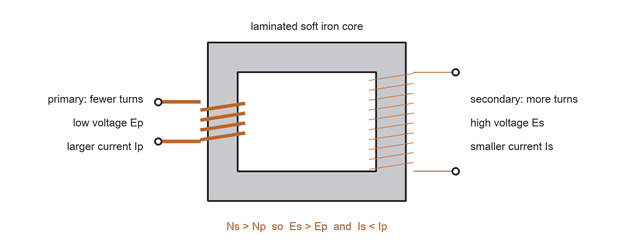
To raise the voltage, the secondary must have more turns than the primary, so the number of turns in the primary is less than the number in the secondary.
The figure shows a laminated soft iron core with a primary of few turns and a secondary of more turns, which gives a higher voltage and a smaller current in the secondary.
(ii)
Step 2 — Name the kind of current.
Only an alternating current sets up a changing flux in the core; a steady d.c. induces no e.m.f. in the secondary. So the transformer is used in alternating (a.c.) current circuits.
(iii)
Step 3 — Compare the frequencies.
The flux in the core changes at the frequency of the input a.c., so the e.m.f. induced in the secondary alternates at that same frequency. A transformer changes the voltage (and the current) but not the frequency, so the frequency remains the same.
Watch out: A transformer changes the voltage and the current, but never the frequency.
Therefore, (i) less, (ii) alternating (a.c.), (iii) remains same.
