
Question 1072 marksEasy
In an a.c. generator, the speed at which the coil rotates is doubled. How would this affect (a) the frequency of the output voltage, (b) the maximum output voltage.
Confirming your payment
Sign up now and get 250 free tokens.
Electro-magnetism · Question 107 of 136
In an a.c. generator, the speed at which the coil rotates is doubled. How would this affect (a) the frequency of the output voltage, (b) the maximum output voltage.
Solution:
Concept: An a.c. generator (dynamo) changes mechanical energy into electrical energy by electromagnetic induction: a coil turned in a magnetic field has a changing flux linked with it, so an alternating e.m.f. is induced. Slip rings keep each end of the coil joined to the same brush, so the output is a.c. One rotation of the coil gives one cycle, so the frequency equals the number of rotations per second. The peak (maximum) e.m.f. is proportional to the speed of rotation, because a faster coil changes the flux faster.
(a)
Step 1 — Find the effect on the frequency.
One rotation of the coil gives one cycle of the output, so the frequency equals the number of rotations per second. When the speed is doubled, the coil makes twice as many rotations every second, so the frequency is doubled.
(b)
Step 2 — Find the effect on the maximum voltage.
By Faraday's law the induced e.m.f. is proportional to the rate of change of the flux. When the coil turns twice as fast, the same change of flux happens in half the time, so the rate of change, and with it the maximum output voltage, is doubled.
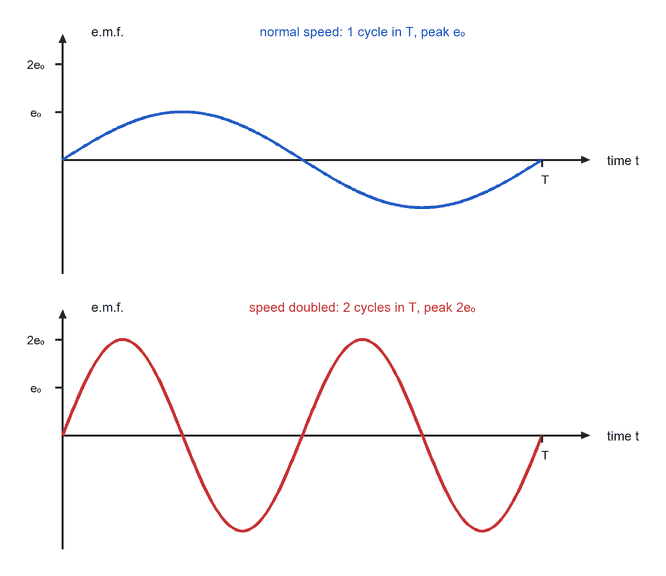
The graph compares the two outputs: at the doubled speed the e.m.f. goes through two cycles in the time T taken for one cycle at the normal speed, and its peak is 2e₀ instead of e₀.
Watch out: Doubling the speed changes BOTH quantities; the frequency does not stay fixed while only the voltage rises.
Therefore, when the speed of the coil is doubled, (a) the frequency of the output voltage is doubled, and (b) the maximum output voltage is also doubled.