
Question 602 marksEasy
State condition in each case for the magnitude of force on a current carrying conductor placed in a magnetic field to be (a) zero, and (b) maximum.
Confirming your payment
Sign up now and get 250 free tokens.
Electro-magnetism · Question 60 of 136
State condition in each case for the magnitude of force on a current carrying conductor placed in a magnetic field to be (a) zero, and (b) maximum.
Solution:
Concept: The force on a current-carrying conductor in a magnetic field depends on the angle θ between the conductor (the current) and the field: F = BIl sin θ. It is greatest when θ is 90° and zero when θ is 0° or 180°.
(a)
Step 1 — Condition for zero force.
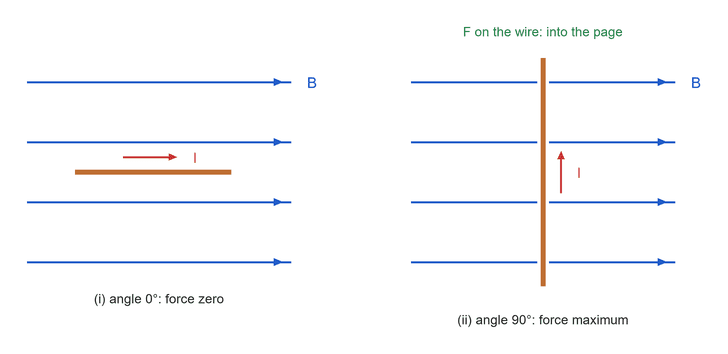
The force is zero when the conductor (the current) is along the magnetic field, parallel or antiparallel to it, because then θ is 0° or 180° and sin θ is zero.
(b)
Step 2 — Condition for maximum force.
The force is maximum when the conductor (the current) is at right angles to the magnetic field, because then θ is 90° and sin θ has its largest value, 1.
The figure shows (i) a wire along the field, with no force, and (ii) a wire at right angles to the field, with the largest force, directed into the page.
Watch out: The force depends on the angle between the conductor and the field, not on the angle between the conductor and the magnet's poles drawn on paper.
Therefore, the force is (a) zero when the conductor is parallel to the magnetic field, and (b) maximum when the conductor is perpendicular to the magnetic field.