
Question 362 marksMedium
How is the working of an electric bell affected, if alternating current be used instead of direct current?
Confirming your payment
Sign up now and get 250 free tokens.
Electro-magnetism · Question 36 of 136
How is the working of an electric bell affected, if alternating current be used instead of direct current?
Solution:
Concept: A piece of soft iron near a magnet pole becomes a magnet itself (induced magnetism): its near side becomes the opposite pole, so soft iron is attracted by either pole of a magnet.
Step 1 — See what a.c. does to the electromagnet.
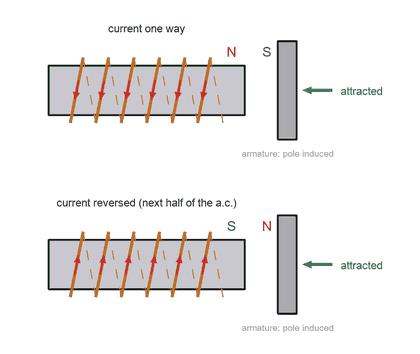
An alternating current reverses its direction many times every second, so the poles of the electromagnet also keep reversing: the end facing the armature is N for one half of the cycle and S for the next.
Step 2 — See what happens to the armature.
The armature is made of soft iron, which is not a magnet of its own. When the core end is N, the near side of the armature becomes S; when the core end is S, the near side becomes N. In both cases the armature is attracted.
The figure shows the core with the current one way (its end near the armature is N) and with the current reversed (that end is S); the induced pole on the armature is opposite each time, so it is attracted both times.
Step 3 — Follow the bell through one cycle.
So the core still pulls the armature, the circuit breaks at the contact screw, the spring brings the armature back, and the cycle repeats as with direct current.
Watch out: The armature would be repelled half the time only if it were a permanent magnet; a soft iron armature is attracted by either pole.
Therefore, the working of the bell is not affected: it still rings with a.c., because the soft iron armature is attracted whichever way the current flows in the coil.