
Question 1122 marksEasy
Name the device used to transform 12 V a.c. to 200 V a.c. Name the principle on which it works.
Confirming your payment
Sign up now and get 250 free tokens.
Electro-magnetism · Question 112 of 136
Name the device used to transform 12 V a.c. to 200 V a.c. Name the principle on which it works.
Solution:
Concept: A transformer works on mutual induction and only with a.c.: the changing current in the primary coil sets up a changing flux in the soft iron core, and this changing flux, linked with the secondary coil, induces an e.m.f. in it. The e.m.f. per turn is the same in both coils, so Es ÷ Ep is equal to Ns ÷ Np (the turns ratio). In an ideal transformer the power in equals the power out, so the current changes the opposite way: Is ÷ Ip is equal to Np ÷ Ns. A step-up transformer has more turns in the secondary than in the primary (Ns > Np), so it raises the voltage and lowers the current. A step-down transformer has fewer turns in the secondary (Ns < Np), so it lowers the voltage and raises the current.
Step 1 — Name the device.
The voltage must be raised from 12 V a.c. to 200 V a.c., so the device is a step-up transformer.
Step 2 — Find the turns ratio it needs.
The turns ratio equals the voltage ratio, so the secondary needs about 16.7 times as many turns as the primary.
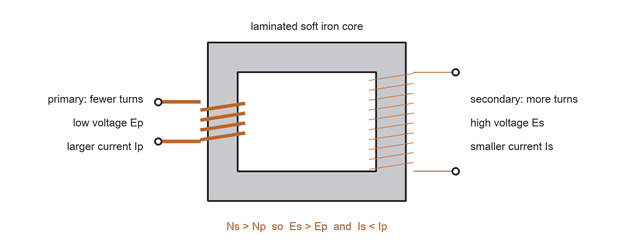
The figure shows the step-up transformer: few turns on the primary (low voltage Ep, larger current Ip) and more turns on the secondary (high voltage Es, smaller current Is).
Step 3 — Name the principle.
It works on electromagnetic induction, in the form called mutual induction. The alternating current in the primary sets up a changing flux in the core, and this changing flux, linked with the secondary, induces an e.m.f. in it.
Watch out: A transformer steps up a.c. only; it would not work on a 12 V d.c. battery.
Therefore, the device is a step-up transformer, and it works on the principle of mutual (electromagnetic) induction.