
Question 1093 marksEasy
State (i) two dis-similarities, and (ii) two similarities between a d.c. motor and an a.c. generator.
Confirming your payment
Sign up now and get 250 free tokens.
Electro-magnetism · Question 109 of 136
State (i) two dis-similarities, and (ii) two similarities between a d.c. motor and an a.c. generator.
Solution:
Concept: A d.c. motor changes electrical energy into mechanical energy, using the force on a current-carrying coil in a magnetic field. An a.c. generator does the reverse: it changes mechanical energy into electrical energy by electromagnetic induction. The two machines are built in almost the same way.
(i)
Step 1 — List the dissimilarities.
The table compares the two machines point by point; any two rows answer this part.
| d.c. motor | a.c. generator |
|---|---|
| Changes electrical energy into mechanical energy. | Changes mechanical energy into electrical energy. |
| Works on the force on a current-carrying coil in a magnetic field. | Works on electromagnetic induction. |
| Uses a split ring commutator. | Uses slip rings. |
| A current is supplied to the coil by a battery. | A current is taken out of the coil to a load. |
(ii)
Step 2 — List the similarities.
The two machines are built in almost the same way, as the two figures show.
1. Both have a coil (armature) of many turns of insulated copper wire, wound on a soft iron core and rotating about an axle.
2. In both, the coil turns in the magnetic field between the poles of a strong magnet (field magnet), and carbon brushes connect the turning coil to the outer circuit.
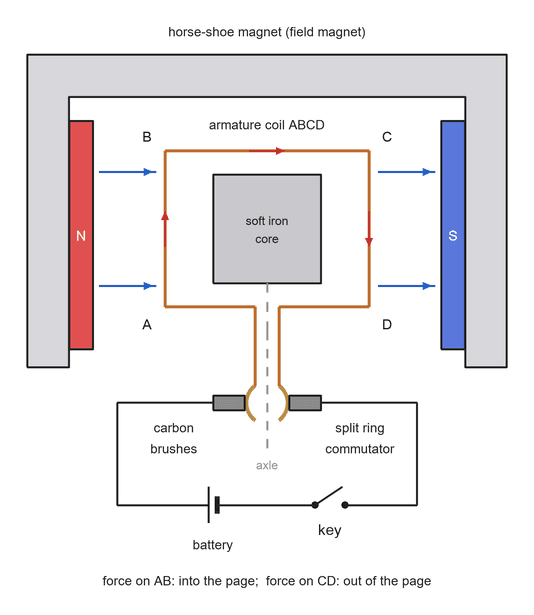
The first figure is the d.c. motor: the coil ABCD, the split ring commutator, the carbon brushes and the battery with a key.
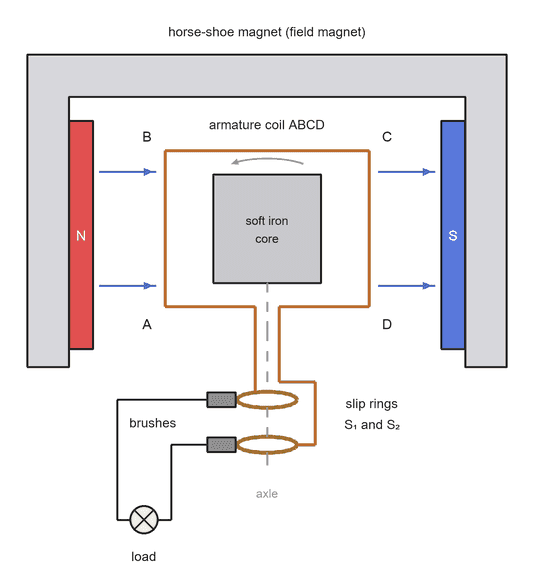
The second figure is the a.c. generator: the same coil and field magnet, but with two slip rings, two brushes and a load.
Watch out: The motor uses a split ring commutator and the a.c. generator uses slip rings; do not mix these up.
Therefore, (i) a d.c. motor changes electrical energy into mechanical energy and uses a split ring commutator, while an a.c. generator changes mechanical energy into electrical energy and uses slip rings; (ii) both have a coil rotating in the field of a strong magnet, and both use carbon brushes to join the coil to the outer circuit.