
Question 992 marksEasy
State Faraday's laws of electromagnetic induction.
Confirming your payment
Sign up now and get 250 free tokens.
Electro-magnetism · Question 99 of 136
State Faraday's laws of electromagnetic induction.
Solution:
Concept: Electromagnetic induction is the production of an e.m.f. in a coil by a change in the magnetic flux linked with it. Faraday's two laws say when this e.m.f. appears and how large it is.
Step 1 — State the first law.
First law: Whenever the magnetic flux linked with a coil changes, an e.m.f. is induced in it. The induced e.m.f. lasts only as long as the change in flux continues, and if the circuit is closed, an induced current flows.
Step 2 — State the second law.
Second law: The magnitude of the induced e.m.f. is directly proportional to the rate of change of the magnetic flux linked with the coil. For a coil of N turns, with a change ΔΦ in the flux through each turn in a time Δt, the e.m.f. is given by this expression.
Step 3 — See what the laws mean.
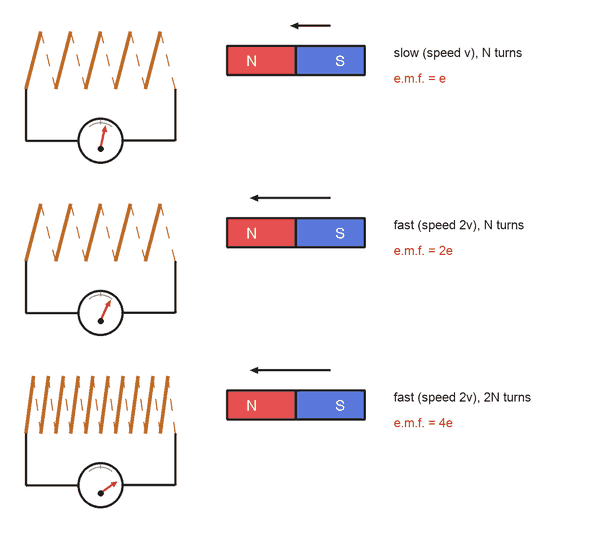
Pushing a magnet into a coil twice as fast doubles the e.m.f.; doubling the number of turns as well doubles it again; holding the magnet still gives no e.m.f. at all.
The figure shows a magnet pushed into a coil of N turns at speed v giving an e.m.f. e, at speed 2v giving 2e, and at speed 2v into a coil of 2N turns giving 4e.
Watch out: The e.m.f. depends on how fast the flux changes, not on how large the flux is.
Therefore, Faraday's laws are: (1) an e.m.f. is induced in a coil whenever the magnetic flux linked with it changes, and it lasts only while the change goes on; (2) the size of this e.m.f. is directly proportional to the rate of change of the magnetic flux linked with the coil.