
Question 501 markMCQEasy
In an electric motor, the energy transformation is from:
Confirming your payment
Sign up now and get 250 free tokens.
Electro-magnetism · Question 50 of 136
In an electric motor, the energy transformation is from:
(A) electrical to mechanical
(B) mechanical to electrical
(C) chemical to light
(D) electrical to chemical
Answer: (A) electrical to mechanical
Concept: A d.c. motor changes electrical energy into mechanical energy. A current-carrying coil placed in a magnetic field feels equal and opposite forces on its two sides, which form a couple and turn it; a split ring commutator reverses the current in the coil every half turn so that it keeps turning the same way.
Step 1 — See what goes in.
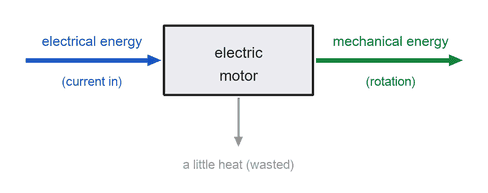
A current from the supply flows through the coil of the motor, so the motor takes in electrical energy.
Step 2 — See what comes out.
The forces on the coil turn it and its axle, so the motor gives out mechanical energy (energy of rotation). A small part of the energy is wasted as heat in the coil.
The figure shows electrical energy going into the motor, mechanical energy coming out, and a little heat wasted.
Watch out: A motor and a generator do opposite jobs; do not mix them up.
Why the other options are wrong:
Therefore, an electric motor changes electrical energy into mechanical energy, option (A).