
Question 431 markMCQEasy
For the inequations A and B [as given above in part (d)], is :
A =

B =

Confirming your payment
Sign up now and get 250 free tokens.
Linear Inequations · Question 43 of 56
For the inequations A and B [as given above in part (d)], is :
A =
B =
(A) 
(B) 
(C) 
(D) 
Answer: (A)
Concept: (A union B) is the set of numbers that are in A or in B (or in both). On number lines drawn one below the other, it is every part that is shaded on at least one line.
Step 1 — Read A and B.
From the figures of part (d):
Step 2 — Find the left end of the union.
The shading starts earliest on B, at −4, and −4 is included in B: a filled circle at −4.
Step 3 — Find the right end of the union.
The shading ends last on A, at 1, and 1 is included in A: a filled circle at 1.
Step 4 — Check for a gap.
A and B overlap between −3 and 0, so there is no gap and the union is one unbroken piece:
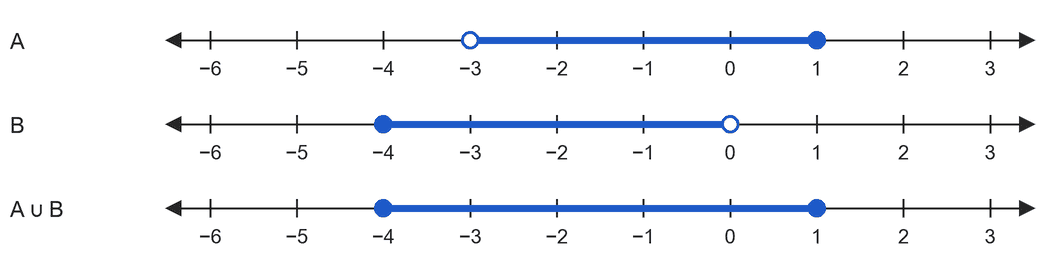
The third line is everything shaded on A or on B. Option (A) shows a filled circle at −4, a filled circle at 1 and the shading between them.
Watch out: A union needs every shaded number from both lines; an option that shows only a piece of A or of B cannot be the union.
Why the other options are wrong:
Therefore, , option (A).