
Question 673 marksEasy
Compare carbon tetrachloride and sodium chloride with regard to solubility in water and electrical conductivity.
Confirming your payment
Sign up now and get 250 free tokens.
Chemical Bonding · Question 67 of 71
Compare carbon tetrachloride and sodium chloride with regard to solubility in water and electrical conductivity.
Solution:
Concept: Electrovalent compounds are made of ions held by strong electrostatic forces in a crystal lattice; covalent compounds are made of molecules, and the forces between molecules are weak. Almost every difference in their properties (state, melting and boiling points, solubility, conductivity) follows from this. An electric current passes through a liquid or a solution only if it contains ions that are free to move. Positive ions (cations) move to the cathode (negative electrode) and negative ions (anions) move to the anode (positive electrode).
Step 1 — Recall the bonding.
CCl₄ is covalent, made of non-polar molecules; NaCl is electrovalent, made of ions.
Step 2 — Compare the properties.
The table compares solubility and conductivity.
| Property | Carbon tetrachloride (CCl₄) | Sodium chloride (NaCl) |
|---|---|---|
| Solubility in water | Insoluble: non-polar molecules are not attracted by polar water | Soluble: polar water pulls the ions apart |
| Electrical conductivity | Non-conductor in all states (no ions) | Conducts in the molten and aqueous states (free ions); not as a solid |
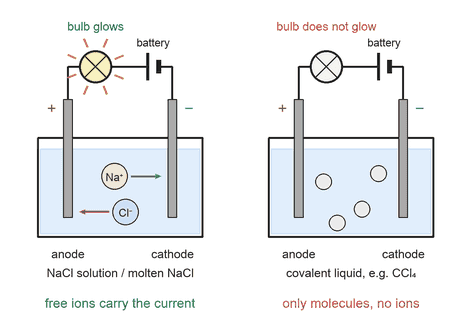
Therefore, CCl₄ is insoluble in water and does not conduct, while NaCl is soluble in water and conducts when molten or dissolved.