Solution:
Concept: Electronegativity is the tendency of an atom to attract a shared pair of electrons towards itself. If the two bonded atoms have equal electronegativity, the pair is shared equally and the bond is non-polar; if one is more electronegative, it pulls the pair closer, gets a partial negative charge (δ−) and the other a partial positive charge (δ+), and the bond is polar.
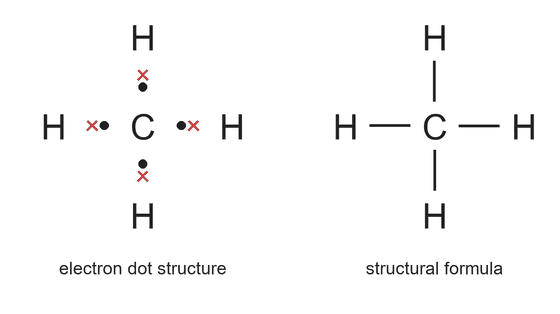
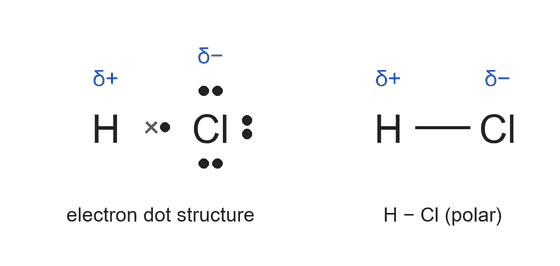
Step 1 — Draw the structures.
(a) Methane shares its four electron pairs almost equally; hydrogen chloride shares its one pair unequally.
Step 2 — Give two differences.
The table compares the two molecules.
| Methane (CH₄) | Hydrogen chloride (HCl) |
|---|
| Non-polar: pairs shared (almost) equally, no partial charges | Polar: shared pair pulled towards Cl, so H is δ+ and Cl is δ− |
| Does not ionise in water; insoluble in water | Ionises in water; its solution conducts electricity |
Step 3 — Name two such compounds.
(b) Hydrogen chloride (HCl) and ammonia (NH₃) are covalent when pure, but both are polar and form ions when dissolved in water.
Step 4 — Ions from hydrogen chloride.
(c) Hydrogen chloride ionises completely in water.
HCl+H2O→H3O++Cl−
The ions are H₃O⁺ (or H⁺) and Cl⁻.
Step 5 — Ions from ammonia.
Ammonia reacts only partly with water, so the reaction is reversible.
NH3+H2O⇌NH4++OH−
The ions are NH₄⁺ and OH⁻.
Therefore, (a) methane is non-polar and HCl is polar, as shown; (b) HCl and NH₃ are covalent but give ions in water; (c) HCl gives H₃O⁺ (H⁺) and Cl⁻, and NH₃ gives NH₄⁺ and OH⁻.
