Solution:
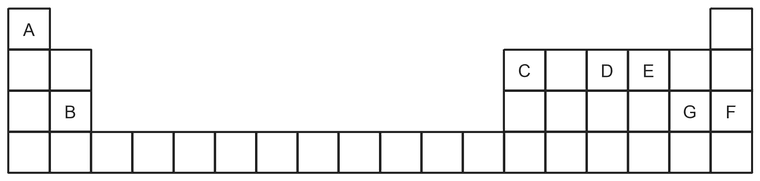
Concept: Identify each element from its position (period = row, group = column), then use its valence electrons. The question says each letter may be used only once.
Step 1 — Identify the elements.
Reading the positions in the extract gives the elements below.

A = hydrogen (period 1, group 1); B = magnesium (period 3, group 2); C = boron, D = nitrogen and E = oxygen (period 2, groups 13, 15, 16); G = chlorine (period 3, group 17); F = argon (period 3, group 18).
Step 2 — Electrovalent compound with G.
(a) Magnesium (B), a metal, gives one electron to each of two chlorine (G) atoms, forming the electrovalent compound BG₂ (MgCl₂). Hydrogen (A) forms a covalent compound with G.
B+G2→BG2
Step 3 — Ion that goes to the cathode.
(b) Cations move to the cathode. Hydrogen (A) forms the cation H⁺. (B also forms a cation, but B is already used in (a) and letters must not be repeated.)
Step 4 — Non-metal of valency 2.
(c) Oxygen (E, 2, 6) is a non-metal that needs 2 electrons, so its valency is 2.
Step 5 — Inert gas.
(d) Argon (F, 2, 8, 8) has a complete octet, so it is an inert gas.
Therefore, (a) B, (b) A, (c) E, (d) F.