Solution:
Concept: compare each pair only on the basis given in brackets.
Step 1 — (a) Function.
| Ureter | Urethra |
|---|
| Carries urine from the kidney (pelvis) to the urinary bladder | Carries urine from the urinary bladder to the outside |
Step 2 — (b) Hormones involved.
| Diabetes mellitus | Diabetes insipidus |
|---|
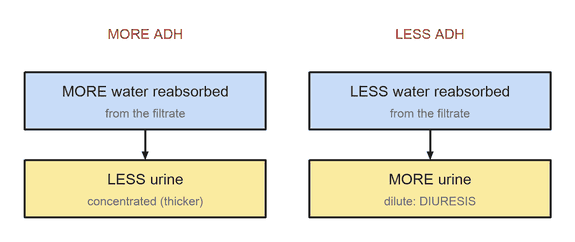
| Lack of insulin (pancreas); sugar passes in urine | Lack of ADH (posterior pituitary); large volumes of dilute urine |
"Insipid" means tasteless: the urine in diabetes insipidus has no sugar.
Step 3 — (c) Abnormal constituents.
| Glycosuria | Albuminuria |
|---|
| Glucose in urine (diabetes mellitus) | Albumin (protein) in urine (high blood pressure or a leaky Bowman's capsule) |
Step 4 — (d) Problem.
| Diuresis | Uremia |
|---|
| Increased production of urine (less ADH, or diuretics like tea, coffee, alcohol) | Build-up of urea in the blood (e.g. cholera or kidney failure); may cause death |
Step 5 — (e) Location.
| Malpighian capsule | Loop of Henle |
|---|
| In the cortex | In the medulla |
Watch out: Answer each pair on its bracketed basis only.
Therefore, the five pairs differ as shown in the tables of Steps 1–5.
