Solution:
Concept: in the diagram A is the renal artery (its arrow points into the kidney: blood coming in) and B is the renal vein (its arrow points away: blood going out).
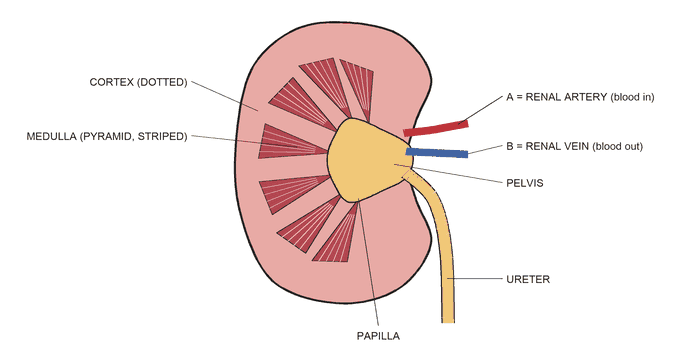
Step 1 — (a)–(d) Parts, unit, function and location.
(a) Between the medulla and the pelvis lie the renal papillae, the tips of the pyramids projecting into the pelvis.
(b) The unit is the nephron (uriniferous tubule).
(c) The kidney removes nitrogenous wastes (chiefly urea), excess salts and water from the blood as urine, and regulates the body's water balance (osmoregulation).
(d) In the abdominal cavity, one on either side of the backbone against the back wall, protected by the last two pairs of ribs.
Step 2 — (e) Blood in A and B.
| Blood in A (renal artery) | Blood in B (renal vein) |
|---|
| Oxygenated: more oxygen, less CO₂ | Deoxygenated: less oxygen, more CO₂ |
| More urea and other nitrogenous wastes | Least urea (filtered blood) |
Step 3 — (f) and (g) Pelvis and osmoregulation.
(f) The collecting ducts of all the nephrons pour urine into the pelvis.
(g) Osmoregulation is the regulation of the amount of water and salts in the blood so that its osmotic pressure stays constant.
Step 4 — (h) and (i) Dialysis and the hormone.
(h) Dialysis (artificial kidney, haemodialysis): the patient's blood is led through a machine that removes urea and excess salts and returns the cleaned blood. With permanent damage it must be repeated regularly, usually two or three times a week, until a kidney transplant can be done.
(i) ADH (antidiuretic hormone, vasopressin), from the posterior pituitary, controls the reabsorption of water.
Step 5 — (j) Draw a Malpighian capsule.
Draw the afferent arteriole wider than the efferent arteriole, and show the filtrate flowing into the tubule:
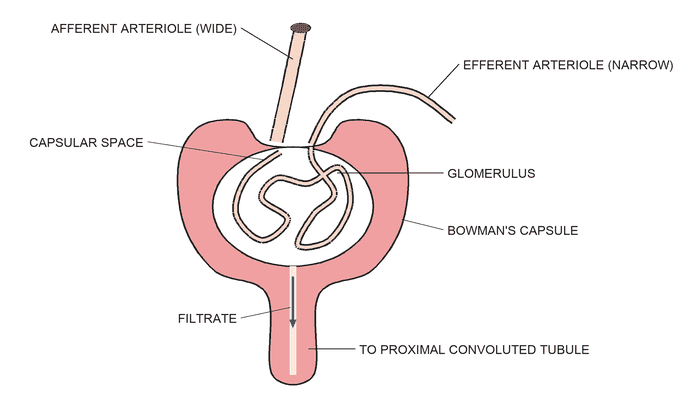
Labels: afferent arteriole, efferent arteriole, glomerulus, Bowman's capsule, capsular space, tubule (to PCT).
Watch out: The vessel whose arrow points into the kidney brings blood in, so it is the artery.
Note: the earlier answer gave the dialysis schedule as about twelve hours twice a week; usual haemodialysis is a few hours, two or three times a week, so the line now says only that it is repeated regularly.
Therefore, (a) renal papillae; (b) nephron; (c) removing nitrogenous wastes as urine and osmoregulation; (d) abdomen, either side of the backbone; (e) A oxygenated with more urea, B deoxygenated with least urea; (f) pelvis; (g) as defined; (h) dialysis; (i) ADH; (j) diagram as drawn.

