Solution:
Concept: in ultrafiltration only the liquid part of the blood is filtered, and the reabsorption that follows is selective.
Step 1 — Statement (i).
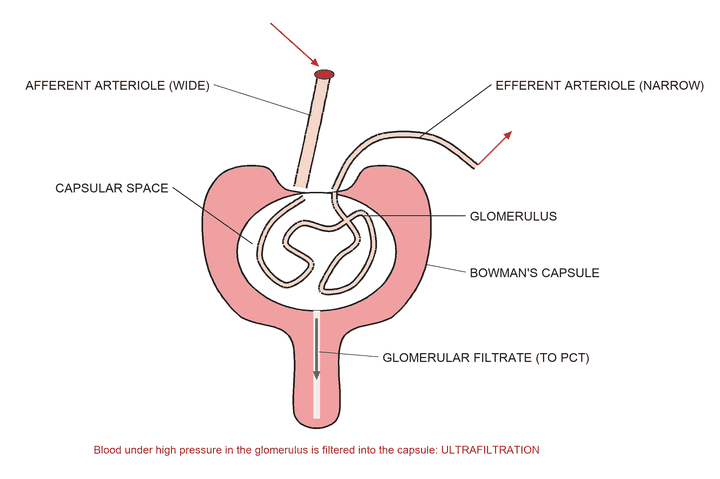
The efferent (outgoing) arteriole is narrower than the afferent (incoming) one, so blood is squeezed in the glomerulus. True.
Step 2 — Statement (ii).
The filtrate has water, urea, salts, glucose and other plasma solutes, but no white blood corpuscles: blood cells and proteins are too large to pass. False.
Step 3 — Statement (iii).
Sodium chloride is reabsorbed only as far as is needed to keep the blood's normal concentration (selective reabsorption); the rest passes out in the urine. False.
Step 4 — Statements (iv) and (v).
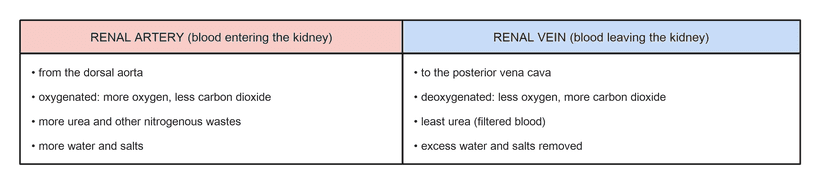
The renal artery branches from the dorsal aorta, so its blood is oxygenated and brings the urea to the kidney: (iv) is True. The renal vein carries deoxygenated blood (the kidney cells have used the oxygen) with the least urea: (v) is False.
Step 5 — Statement (vi).
Excess uric acid (and salts such as calcium oxalate) can crystallise into kidney stones. True.
Watch out: In (v) the renal-vein blood is deoxygenated (and still carries a little urea), so the statement is false.
Therefore, (i) True; (ii) False; (iii) False; (iv) True; (v) False; (vi) True.
