
Question 311 markMCQEasy
The blood vessel which carries blood from the stomach and intestine to the liver :
Confirming your payment
Sign up now and get 250 free tokens.
The Circulatory System · Question 31 of 65
The blood vessel which carries blood from the stomach and intestine to the liver :
(A) Hepatic artery
(B) Carotid artery
(C) Hepatic vein
(D) Hepatic portal vein
Answer: (D) Hepatic portal vein
Concept: veins from the stomach and intestine do not go straight to the posterior vena cava; they first join to form the hepatic portal vein, which enters the liver.
Step 1 — Collect.
The food absorbed in the stomach and intestine is collected by the hepatic portal vein.
Step 2 — Process in the liver.
In the liver this vein breaks up into capillaries again, so the liver can store excess sugar as glycogen and make harmful substances harmless.
Step 3 — Leave the liver.
The hepatic vein then carries the blood from the liver to the posterior vena cava.
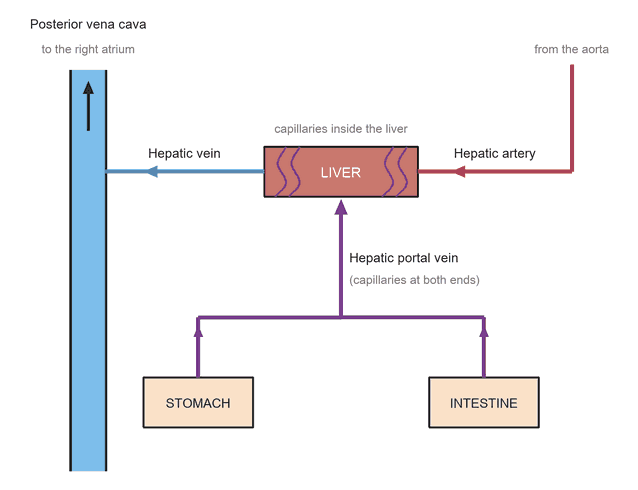
Watch out: The hepatic vein leaves the liver; the hepatic portal vein enters it.
Why the other options are wrong:
Therefore, blood goes from the stomach and intestine to the liver by the hepatic portal vein, option (D).