Solution:
Concept: match each item in Column A with the term or value in Column B that names or measures it.
Step 1 — Match the heart items.
The impulse that starts each heart beat arises in the SA node, so it is the pacemaker: (a) → (iii). It passes to the AVN, the bundle of His and the Purkinje fibres, the special muscle fibres in the ventricle walls: (c) → (v). Cardiac muscle works all through life without tiring: (e) → (vi). One full cardiac cycle takes 0.15 s + 0.30 s + 0.40 s = 0.85 s: (f) → (vii).

Step 2 — Match the blood items.
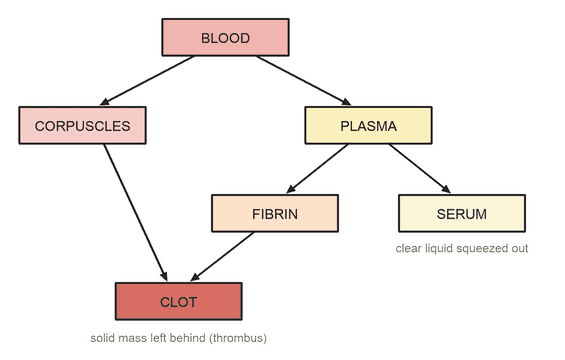
In sickle cell anaemia the haemoglobin of the RBCs is defective: (b) → (iv). The liquid squeezed out of a clot is serum: (d) → (ii). The liquid part of blood without corpuscles is plasma: (g) → (i).
Step 3 — Write the pairs.
| Column A | Column B |
|---|
| (a) SA Node | (iii) Pacemaker |
| (b) Defective haemoglobin in RBC | (iv) Sickle cell anaemia |
| (c) Muscle fibres located in heart | (v) Purkinje fibres |
| (d) The liquid squeezed out of blood during clotting | (ii) Serum |
| (e) Never tires, keep on contracting and relaxing | (vi) Cardiac muscle |
| (f) Cardiac cycle | (vii) 0.85 sec |
| (g) Liquid part of the blood without corpuscles | (i) Plasma |
Watch out: Plasma and serum differ: serum is plasma without fibrinogen, left after clotting.
Therefore, (a)–(iii), (b)–(iv), (c)–(v), (d)–(ii), (e)–(vi), (f)–(vii), (g)–(i).
