Solution:
Concept: these are short naming facts from the whole chapter; give exactly the number of names asked for.
Step 1 — (a)–(c) Parts, cells and vessels.
(a) The circulatory system is made of the heart, blood and blood vessels.
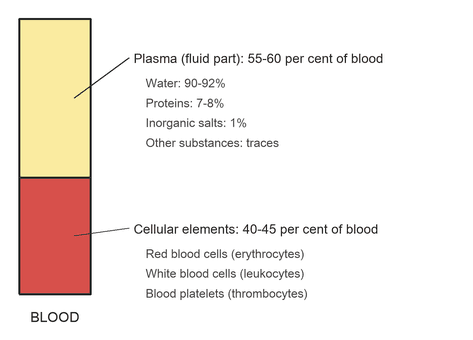
(b) The three kinds of blood cells are red blood cells (erythrocytes), white blood cells (leukocytes) and blood platelets (thrombocytes).
(c) The three kinds of blood vessels are arteries, veins and capillaries.
Step 2 — (d)–(e) Circulating and non-circulating fluids.
(d) Blood, tissue fluid and lymph are the three principal body fluids that move round the body. Blood and lymph flow in their own vessels; tissue fluid moves between them through the spaces between the cells.

(e) Synovial fluid (in the joint cavities), vitreous humour (in the eye) and pericardial fluid (round the heart) stay in one organ and do not circulate.
Step 3 — (f)–(g) Lymphatic organs and blood components.
(f) The spleen and the tonsils.
(g) Plasma (the fluid part) and the cellular elements (cells and platelets).
Step 4 — (h)–(j) Systems, haemoglobin and circulations.
(h) An open circulatory system (insects: blood flows through open body spaces) and a closed one (humans: blood stays in vessels).
(i) Haemin (the iron-containing part) and globin (a protein).
(j) Pulmonary circulation and systemic circulation.
Watch out: In (d) the book counts tissue fluid with blood and lymph as the three circulating fluids, even though tissue fluid has no vessels.
Therefore, (a) heart, blood, blood vessels; (b) RBCs, WBCs, platelets; (c) arteries, veins, capillaries; (d) blood, tissue fluid, lymph; (e) synovial fluid, vitreous humour, pericardial fluid; (f) spleen, tonsils; (g) plasma, cellular elements; (h) open, closed; (i) haemin, globin; (j) pulmonary, systemic.
