
Question 22 marksEasy
In a coloured diagram, why do we generally show the pulmonary artery in blue and pulmonary vein in red colour ?
Confirming your payment
Sign up now and get 250 free tokens.
The Circulatory System · Question 2 of 65
In a coloured diagram, why do we generally show the pulmonary artery in blue and pulmonary vein in red colour ?
Solution:
Concept: in a coloured diagram, the colour shows the kind of blood a vessel carries, not whether the vessel is an artery or a vein: red = oxygenated blood, blue = deoxygenated blood.
Step 1 — Recall the usual pattern.
Most arteries carry oxygenated blood away from the heart, so arteries are usually drawn red. Most veins carry deoxygenated blood back to the heart, so veins are usually drawn blue.
Step 2 — Look at the pulmonary artery.
The pulmonary artery arises from the right ventricle, which holds blood collected from the body. This blood is deoxygenated, and the artery takes it to the lungs to be oxygenated. So it is drawn blue, although it is an artery.
Step 3 — Look at the pulmonary vein.
The pulmonary veins bring blood from the lungs, where it has just picked up oxygen, to the left atrium. This blood is oxygenated, so they are drawn red, although they are veins.
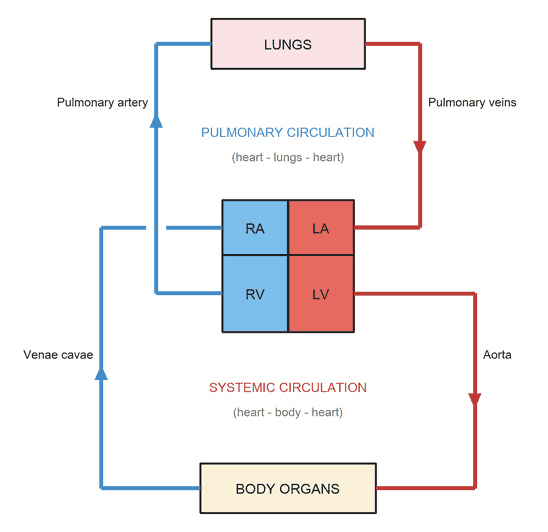
Watch out: Real deoxygenated blood is dark red, never blue; blue is only a convention of the diagram.
Therefore, the pulmonary artery is shown blue because it carries deoxygenated blood (to the lungs), and the pulmonary vein is shown red because it carries oxygenated blood (from the lungs); they are the exceptions to "arteries red, veins blue".