
Question 331 markMCQEasy
A human heart has four chambers and four valves to regulate the process of blood circulation in the body. What kind of phases would occur when blood is supplied to Aorta and Pulmonary Artery from the chambers of the heart ?
Confirming your payment
Sign up now and get 250 free tokens.
The Circulatory System · Question 33 of 65
A human heart has four chambers and four valves to regulate the process of blood circulation in the body. What kind of phases would occur when blood is supplied to Aorta and Pulmonary Artery from the chambers of the heart ?
(A) Atrial systole and ventricular diastole.
(B) Ventricular systole and Atrial diastole.
(C) Right ventricular systole and left ventricular diastole.
(D) Left atrial systole and right atrial diastole.
Answer: (B) Ventricular systole and Atrial diastole.
Concept: the aorta and the pulmonary artery arise from the ventricles, so blood enters them only when the ventricles contract (ventricular systole).
Step 1 — Ventricles contract.
In ventricular systole the ventricular muscles contract. The tricuspid and bicuspid valves close, so blood cannot return to the atria.
Step 2 — Arteries fill.
The semilunar valves open, and blood passes into the pulmonary artery (from the right ventricle) and the aorta (from the left ventricle).
Step 3 — Atria relax.
At the same time the atria relax (atrial diastole) and fill with blood from the venae cavae and the pulmonary veins.
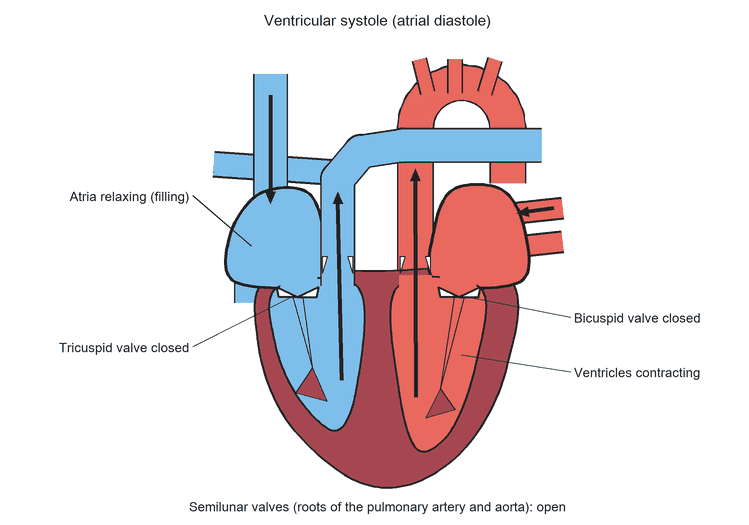
Watch out: The two ventricles always contract together, and so do the two atria.
Why the other options are wrong:
Therefore, blood is supplied to the aorta and pulmonary artery during ventricular systole and atrial diastole, option (B).