
Question 5012 marksEasy
Define the following terms :
(a) Circulatory system
(b) Blood
(c) Heart
(d) Diapedesis
(e) Phagocytosis
(f) Rh factor
Confirming your payment
Sign up now and get 250 free tokens.
The Circulatory System · Question 50 of 65
Define the following terms :
(a) Circulatory system
(b) Blood
(c) Heart
(d) Diapedesis
(e) Phagocytosis
(f) Rh factor
Solution:
Concept: a good definition says what the thing is and what it does.
Step 1 — (a) Circulatory system.
The system made of the heart, blood and blood vessels (arteries, veins and capillaries) that transports substances to and from all parts of the body: food, oxygen and hormones to the cells; carbon dioxide and other wastes away from them.
Step 2 — (b) Blood.
A fluid connective tissue made of the liquid plasma and the cellular elements (RBCs, WBCs and platelets), which circulates in the heart and blood vessels, transports materials and protects the body.
Step 3 — (c) Heart.
A hollow, four-chambered muscular organ that pumps blood through the blood vessels by rhythmic contraction and relaxation. It lies between the two lungs, above the diaphragm, and is about the size of a closed fist.
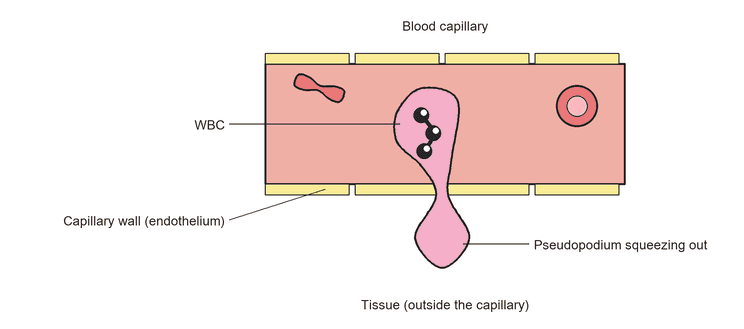
Step 4 — (d) Diapedesis.
The squeezing of white blood cells through the walls of the capillaries into the tissues. The amoeboid WBC pushes out a pseudopodium, slips through the thin wall and reaches the germs.
Step 5 — (e) Phagocytosis.
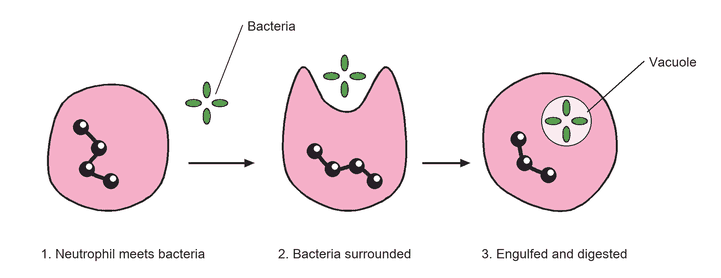
The engulfing of solid particles, especially bacteria, by WBCs, particularly the neutrophils; a defence against germs.
Step 6 — (f) Rh factor.
A protein (the D antigen) present on the surface of the RBCs of most people. A person who has it is Rh-positive; one who lacks it is Rh-negative. Rh stands for Rhesus, the monkey in which it was first found.
Watch out: Diapedesis is moving out of a capillary; phagocytosis is eating germs.
Therefore, the six terms are defined as in Steps 1–6.