Solution:
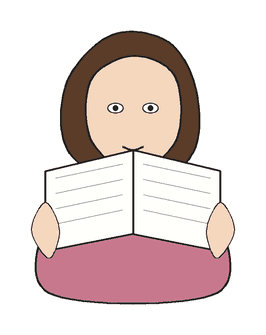
Concept: The girl holds her book very close to her eyes, so she sees only near objects clearly: she is short-sighted.
Step 1 — (a) Name the problem.
She needs the book close to see it, so she has myopia (short-sightedness).
Step 2 — (b) The conditions in A and B.
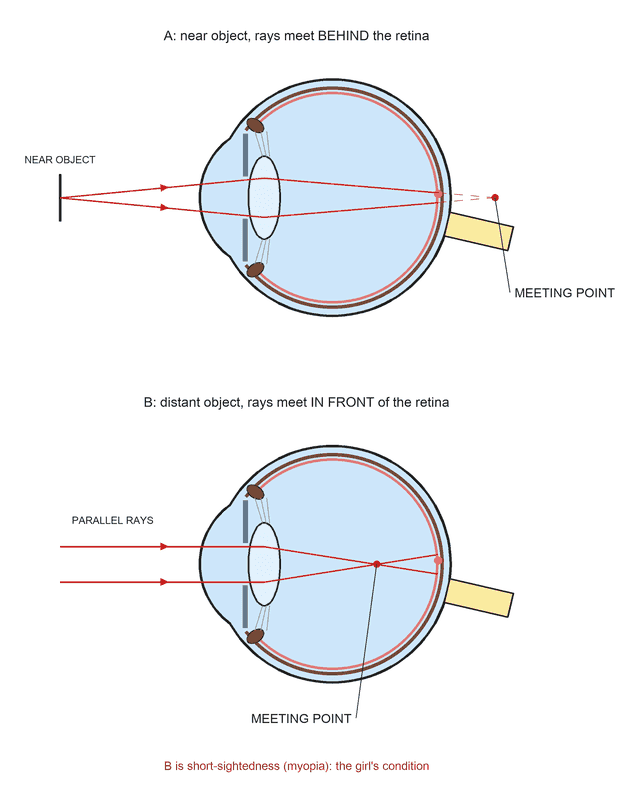
A: rays from a near object meet behind the retina – the condition of hyperopia, which does not apply to her. B: parallel rays from a distant object meet in front of the retina – myopia, which applies to her.
Step 3 — (c) Glasses she needs.
Spectacles with concave (diverging) lenses of minus power: they spread the rays before they enter the eye, so that the rays meet on the retina.
Watch out: A book held very close means near objects are clear and distant ones are not – myopia, not hyperopia.
Therefore, (a) myopia; (b) A hyperopia (not hers), B myopia (hers); (c) concave lenses.