Solution:
Concept: Each cause produces one particular defect of the eye; match them one by one.
Step 1 — Match each cause with its defect.
Think of what each change does to the image:
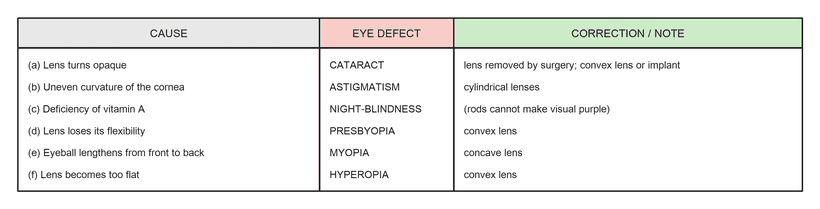
| Cause | Eye defect |
|---|
| (a) Lens turns opaque | Cataract |
| (b) Uneven curvature of the cornea | Astigmatism |
| (c) Deficiency of vitamin A | Night-blindness |
| (d) Lens loses its flexibility | Presbyopia |
| (e) Eye ball lengthens from front to back | Myopia (short-sightedness) |
| (f) Lens becomes too flat | Hyperopia (long-sightedness) |
Step 2 — See why the less obvious ones fit.
Vitamin A is needed for the rods' visual purple, so without it the rods fail in dim light (c). An ageing lens cannot thicken for near objects (d). In myopia the image forms in front of the retina, and in hyperopia behind it (e, f).
Watch out: Presbyopia (old age, stiff lens) and hyperopia (short eyeball or flat lens) both blur near objects, but their causes differ.
Therefore, (a) cataract, (b) astigmatism, (c) night-blindness, (d) presbyopia, (e) myopia, (f) hyperopia.
