Solution:
Concept: Each description points to one part or one property of the eye; find each in the section of the eye.
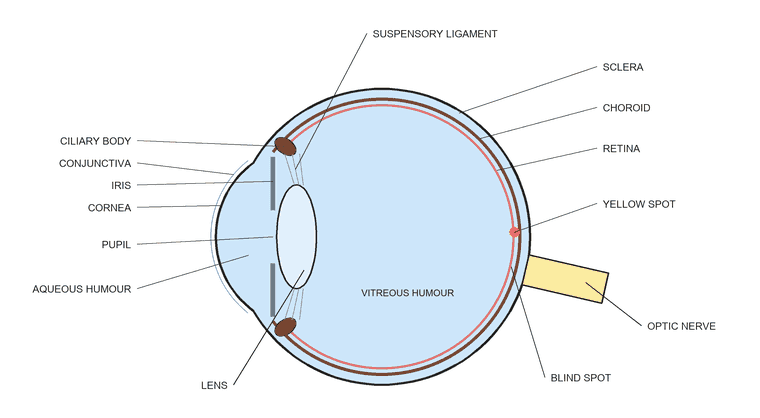
Step 1 — (i) Place of best vision.
The yellow spot (macula lutea) has the greatest number of sensory cells, especially cones.
Step 2 — (ii) Place of no vision.
The blind spot, where the nerve fibres leave the eyeball as the optic nerve, has no sensory cells.
Step 3 — (iii) Cells sensitive to dim light.
The rods contain the pigment rhodopsin and work in dim light; they do not detect colour.
Step 4 — (iv) Opening enclosed by the iris.
The pupil; its size is adjusted by the muscles of the iris.
Step 5 — (v) Fibres holding the lens.
The suspensory ligament attaches the lens to the ciliary body.
Step 6 — (vi) Focusing at different distances.
This capacity is accommodation (power of accommodation), brought about by changing the curvature of the lens.
Step 7 — (vii) Lens for near-sightedness.
Near-sightedness is myopia, in which the image of a distant object forms in front of the retina; a concave (diverging) lens corrects it.
Step 8 — (viii) Layer like the black lining of a camera.
The choroid; its dark pigment stops light from reflecting inside the eye, just as the black lining does in a camera box.
Watch out: The yellow spot is the place of best vision and the blind spot of no vision; do not swap them.
Therefore, (i) yellow spot, (ii) blind spot, (iii) rods, (iv) pupil, (v) suspensory ligament, (vi) accommodation, (vii) concave lens, (viii) choroid.
