Answer: (B) (2) A is False and R is True
Concept: In an assertion–reason item, judge the Assertion (A) and the Reason (R) separately as true or false. Here the four choices only ask whether each statement is true, so we do not have to decide whether R explains A. Here, the cornea and lens form a real, inverted image on the retina; the brain interprets it as upright.
Step 1 — Judge the Assertion (A).
False. The image on the retina is real but inverted (upside down), not straight.
Step 2 — Judge the Reason (R).
True. Impulses from the retina go along the optic nerve to the brain, which 'sees' the object upright, and the two images from the two eyes overlap so that we see one image.
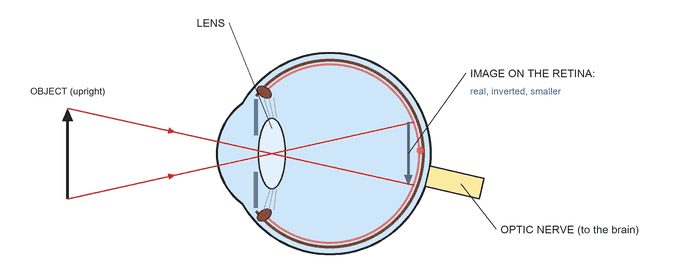
Watch out: The image is inverted on the retina; it is the brain that makes us see it upright.
Why the other options are wrong:
- (A) (1) A is True and R is False: It calls the Assertion true, but the Assertion is false; and it calls the Reason false, but the Reason is true.
- (C) (3) Both A and R are True: It calls the Assertion true, but the Assertion is false.
- (D) (4) Both A and R are False: It calls the Reason false, but the Reason is true.
Therefore, A is false and R is true, option (B).
