Answer: (B) (2) A is False and R is True
Concept: In an assertion–reason item, judge the Assertion (A) and the Reason (R) separately as true or false. Here the four choices only ask whether each statement is true, so we do not have to decide whether R explains A. Here, the lacrimal (tear) gland pours its secretion, tears, through ducts on to the eye; tears contain the enzyme lysozyme.
Step 1 — Judge the Assertion (A).
False. The lacrimal gland is not an endocrine gland, because it pours tears out through ducts; and the enzyme in tears is lysozyme, not thrombokinase (a blood-clotting factor).
Step 2 — Judge the Reason (R).
True. The gland lies in the upper outer part of the orbit, and tears lubricate the eye and are antiseptic because of lysozyme.
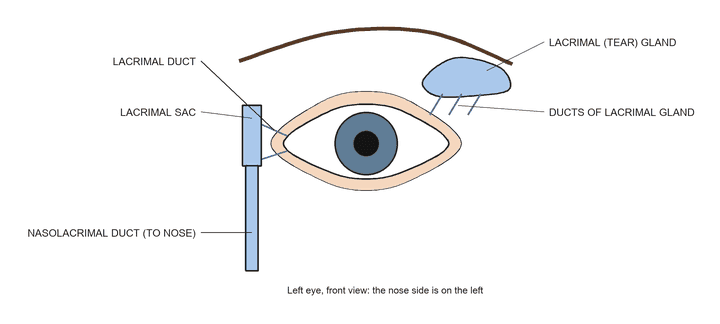
Watch out: A gland with ducts is an exocrine gland; endocrine glands are ductless.
Why the other options are wrong:
- (A) (1) A is True and R is False: It calls the Assertion true, but the Assertion is false; and it calls the Reason false, but the Reason is true.
- (C) (3) Both A and R are True: It calls the Assertion true, but the Assertion is false.
- (D) (4) Both A and R are False: It calls the Reason false, but the Reason is true.
Therefore, A is false and R is true, option (B).
